Monday, July 31, 2023

Oregon Cannabis: What to Expect from OLCC This Fall

Fall is always eventful in Oregon cannabis. Croptober is an Oregon cannabis tradition— hopefully the crops come in lee of any wildfires. We also have administrative rulemaking annually once summer winds down, typically with public input via multiple rules advisory committees (RACs). That’s what I’m here to discuss.

This year, the Oregon Liquor and Cannabis Commission (OLCC) likely will look at, to start: temporary rules it had adopted under the Governor’s clumsy tax compliance mandate; the 2023 legislative session’s new cannabis laws; leftover business from the 2022 session, and certain COVID-era policies. I say “likely” because the Commission’s call for participation was vague, soliciting only “varied perspectives, backgrounds and expertise.” It did not identify topics for rulemaking.

All of this will take place while new Commission leadership awaits the “audit of the audit” commissioned by the Oregon Department of Justice, and conducted by a Sacramento law firm. Whether and when DOJ will release those findings — on potential corruption in the Secretary of State’s recent review of Oregon’s cannabis program– is anyone’s guess. Fallout from the La Mota scandal continues unabated in any case.

But life must go on. Below are a few of the rulemaking issues I am looking at this fall, following discussion with OLCC.

Tax compliance rules

On June 15, the OLCC approved temporary rules requiring licensed marijuana retailers to obtain a Certificate of Tax (“Certificate”) from the Oregon Department of Revenue (“DOR”), as a condition for acquiring or renewing a marijuana retailer license. A Certificate is also needed for changes of ownership, and for adding someone to a license.

We’re midstream on a couple of business sales where Certificates are required. Believe me when I say the rule can be far-reaching. To the positive, DOR is quick to enlist delinquent taxpayers (on any industry) for payment plans. They want the money after all. But this is all very new to the cannabis space.

An interesting issue to parse in “permanent” rulemaking will be whether OLCC makes tax compliance an annual criterion, or whether licensees will be monitored for noncompliance throughout the year. The former seems more likely. I don’t believe OLCC wants to deal with tax compliance intermittently, especially given the prospect of people falling in and out of compliance with DOR plans. I also don’t expect to see a significant number of license cancellations for noncompliance in this rule’s first year.

Whether or how the temporary rule will be updated is anyone’s guess. I don’t like the rule as it stands today. It was an awkward overreach at a terrible time, and I hope to see things reined in via permanent rulemaking. Once again, the request would simply be for cannabis businesses to be treated similarly to businesses in other industries.

“Basic bill and technical”

Basic bill and technical is a general term for rules needed to implement new cannabis laws passed by the legislature in any given year. At the close of the session in June, I explained that there were three such bills in 2023. Of those three, only HB 2931 should spur RAC activity.

HB 2931 creates a “cannabis reference laboratory to support enforcement of cannabis regulation.” I won’t rehash everything I wrote last month; however, suffice it to say that testing has been in the news a lot lately. This is because of the newish aspergillus testing rules and last week’s petition by various parties at the Oregon Court of Appeal to halt their implementation. Due to this aspergillus saga, I expect the state cannabis lab RAC to garner more attention than it may have.

License reassignment program (social equity)

This one is not being publicized, but I’m told it will happen. This rulemaking will arise from Oregon’s mealy-mouthed HB 4016— a foray into cannabis social equity which doesn’t mention “social equity” or any similar concept. For backstory on this, I would direct you to read Jesse Mondry’s helpful blog post from March of 2022, covering HB 4016 and what it means for OLCC.

I’m advised that OLCC personnel have been in touch with other states recently on cannabis social equity. A big difference between Oregon and many of those states is the Beaver State never got funding. That makes for a heavier lift; but the idea right now is to use criteria from another bill passed in the 2022 legislative session– HB 1579, to implement HB 4016. The former bill, titled the Equity Investment Act, set out “equity risk factors” that conveniently have been vetted by state Department of Justice.

Business Oregon already has distributed money to grantees pursuant to 1579. Using such criteria for OLCC license reassignment under HB 4016 rules would certainly shortcut things. It could also insulate the Commission from litigation and, most importantly, diversify the pool of licensees. That’s the theory anyway.

Drive-up windows; on-site delivery

During COVID, OLCC allowed both walk-up and drive-thru cannabis purchases from licensed retailers. The Commission also relaxed rules around on-site delivery. Eventually, the drive-thru allowance was rescinded, although people still buy and sell cannabis in that manner and OLCC admittedly is not enforcing the drive-thru prohibition. Related to this, OLCC noted last year that was “obvious… that a separate rulemaking process focusing solely on drive-up and delivery rules is needed.”

It’s about that time. I’m hopeful the Commission adopts a permanent rule allowing drive-thru pickup of cannabis, similar to what is allowed with alcohol. The arguments put forth by law enforcement to prohibit drive-thru cannabis purchase simply aren’t convincing. If intoxicated driving isn’t a concern for alcohol pick-up, it shouldn’t be for cannabis.

Miscellaneous topics

I’m setting this out as a category, though I’m not sure what, if anything, will materialize. I’d personally like to see OLCC rulemaking around “temporary authority” for incoming licensees in purchase and sale transactions, similar to what happens on the alcohol side. There is some debate in the Commission about whether this could be done through rulemaking or whether a statutory change is required. Rulemaking here could help deal with the problematic services agreement protocol still utilized in many sales, and OLCC’s disinterest in enforcing any “financial interest” rules related to those agreements— especially for expanding legacy operators.

____________________________________________

If you’re interested in any of the topics covered above, or anything related to Oregon cannabis regulation, consider volunteering your time for one of the OLCC RACs. The application link is here. Note that submissions received before August 8 will receive “priority consideration.” So get ‘em in soon– and enjoy the rest of your summer!

The post Oregon Cannabis: What to Expect from OLCC This Fall appeared first on Harris Bricken Sliwoski LLP.


from Canna Law Blog™ https://ift.tt/2J5ErvK
via IFTTT

Serve yourself some Georgia Pie—August’s Leafly Highlight strain

Gelatti x Kush Mints keeps the party lit.

The post Serve yourself some Georgia Pie—August’s Leafly Highlight strain appeared first on Leafly.


from Leafly https://ift.tt/u9AKPNk
via IFTTT

Friday, July 28, 2023

U.S. Import and Export of Marijuana, Hemp and Paraphernalia: Webinar Recap

In case you missed our webinar this week, “U.S. Import and Export of Marijuana, Hemp and Paraphernalia”, the replay video is just above. And if you don’t have an hour to spare, below are highlights of what our cannabis and international trade lawyers had to say about the status and pitfalls of the international marijuana trade. 

U.S. companies are moving into international cannabis trade

Despite the current financial struggles for many U.S.-based cannabis companies, the international cannabis trade is growing. In particular, there’s a renewed demand internationally for hemp and hemp-derived products. Hemp seeds are seeing more traction on the international trade stage; and following on a Drug Enforcement Administration (DEA) letter last year, some companies have even begun to export seeds that will ultimately germinated into high-THC plants. Furthermore, otherwise illegal drug paraphernalia (under federal law) has been allowed to enter U.S. borders in certain cases

The 2018 Farm Bill legalized hemp and its derivatives, removing hemp from the definition of “marijuana” pursuant to the Controlled Substances Act. As a result, hemp and hemp-derived products, such as CBD, are no longer illegal controlled substances (so long as they contain no more than 0.3% delta-9 THC) and, therefore, now legal to import and export (see here and here for United States Department of Agriculture (USDA) guidance on the topic). Don’t forget though that the Food and Drug Administration (FDA) takes major issue with CBD in the food, beverage and supplements space, especially  regarding health and bodily claims under the Food, Drug & Cosmetic Act.

How to import/export cannabis products to and from the U.S.

Know the international trade and cannabis laws and regulations at home and abroad, and don’t bother “port shopping”

In order to import/export cannabis and cannabis paraphernalia, you must know the applicable laws and regulations for the countries of origin and destination, including the specific requirements of customs and border agencies. Of course, in all countries, only specific types of cannabis products are going to be lawful: generally, hemp and hemp derivatives. Some countries dictate that hemp products cannot contain more than .1% THC (rather than the .3% we see here in the states). Others ban synthetic cannabinoids.

Be mindful that, for both import and export analysis, certain U.S. states restrict products that the federal government hasn’t banned, which could make even getting to a port challenging. Finally, As far as the U.S. goes, the concept of port-shopping for a friendlier point of entry (even in states that legalized medical or adult-use marijuana) won’t matter since customs/trade enforcement is centralized and state marijuana laws won’t be a priority anyway.

Pick a marijuana-friendly country for marijuana imports or exports

Medical marijuana import and export is exceedingly difficult in the U.S. and can only be done pursuant to DEA licenses. Companies able to pull import/export permits for medical marijuana in the U.S. are true unicorns, and much choose countries that are progressive when it comes to medical marijuana imports/exports. That list has considerably expanded over the years, and now includes at least Canada, the Netherlands, Germany, Uruguay, Colombia, Israel, Jamaica, South Africa, Lesotho or Australia.

The U.S. has enhanced standards of operation for importers of record

Additionally in the U.S., among the myriad federal trade laws and regulations you must know, in addition to the hemp laws, U.S. trade laws place a legal burden on the importer of record to exercise “reasonable care” to make sure that imported products are accurately declared to U.S. Customs and Border Protection (CBP).

CBP is the federal agency responsible for ensuring that imported goods are allowed to enter only if they are in compliance with all applicable U.S. laws and regulations. CBP coordinates with a wide range of partner government agencies (e.g., FDA, EPA, DOT, ATF, CPSC, etc.) that have expertise in the laws and regulations applicable to particular products. CBP coordinates with the DEA to implement and enforce the relevant provisions of the Controlled Substances Import and Export Act which makes it a crime to bring controlled substances into the country without a proper license.

An indicator of an importer exercising reasonable care is when they seek assistance from a qualified expert who can assist this evaluation. We tell our clients that the gold standard for exercising reasonable care is when importers submit to CBP a formal ruling request for the product in question. Typically CBP ruling requests usually involve determining the appropriate tariff classification, valuation, or country of origin. CBP has issued plenty of rulings on whether products such as tobacco leaf wraps, water pipes, or grinders are drug paraphernalia. CBP has also issued tariff classification rulings on CBD oil and distillates and hemp biomass.

Hire knowledgeable people to help you get through the cannabis import and export process

A cannabis lawyer should not be dabbling in international trade law and vice versa. If you already have your knowledgeable cannabis lawyer, great. But you’re going to need an international trade expert, too.

Importing or exporting cannabis is a complex process to navigate. First, you must determine the permissibility of the import or export under existing controls. Such an endeavor generally requires working with an attorney experienced in international trade laws. When the product doesn’t appear on the Commerce Control List (CCL) — a set of standards determining whether an item can be shipped and where — a knowledgeable professional can help you move forward.

Articles on the CCL will have an Export Control Classification Number (ECCN)  based on their characteristics, which determines whether exporting them requires a license. In the absence of an ECCN, items may be designated as EAR99, which means exporting them does not call for specific licensure.

Items assigned an ECCN generally fall into categories such as electronics or technology, but it is still worthwhile to have an experienced legal expert review your product to ensure an ECCN does not apply. At that point, you can have your professional obtain a Commodity Classification Automated Tracking System (CCATS) number from the Bureau of Industry and Security (BIS) to give the product a formal classification.

Although not every circumstance requires it, a CCATS may provide assurances to finance partners, customs brokers and receiving entities by demonstrating that you went through the proper channels to export your product. That means it may be easier to find a suitable consignee in your destination and get the necessary permits.

Diligence your international cannabis trade partners

After obtaining a CCATS, exporters should conduct due diligence on any partner in the transaction and the ultimate product destination. Due to embargoes, export to Cuba, North Korea, Syria and Iran are impermissible except by explicit licensing from appropriate U.S. agencies. All parties to the transaction — including entities and their majority stakeholders — should also clear the restricted-parties lists with the BIS and the Office of Foreign Assets Control.

The future of cannabis and marijuana paraphernalia imports/exports

Obviously, marijuana products (i.e., containing more than .3% delta-9 THC) are still federally illegal in the U.S. There is no lawful market for their import/export (with the exceptions blessed by the DEA mentioned above). However, hemp (including “marijuana” seeds) and hemp derived products are picking up speed in the international marijuana trade.

Overall, the process is complex and fraught with legal pitfalls. The international cannabis trade is nonetheless an opportunity for businesses to diversify and expand their reach across the globe. If you’re contemplating the import or export of cannabis or paraphernalia, you’re definitely onto something. Know the game and proceed with caution given the compliance obligations and everchanging dynamics of the international cannabis trade.

The post U.S. Import and Export of Marijuana, Hemp and Paraphernalia: Webinar Recap appeared first on Harris Bricken Sliwoski LLP.


from Canna Law Blog™ https://ift.tt/3aJ2Grq
via IFTTT

Thursday, July 27, 2023

Strategies for Distressed Cannabis Businesses

It’s pretty easy to write about everything that’s going wrong in today’s cannabis industry. Today, I want to change gears and talk about some of the strategies we’ve seen work for distressed cannabis businesses in the past. Yes, some of these strategies may seem obvious at first. But pulling them off correctly – especially in a highly regulated market – may be a challenge.

What I’m about to talk about might not work for every cannabis business and certainly not for every problem they face. And this is certainly not legal advice. The point I’m trying to make is that despite being in an over-taxed, over-regulated, industry on the edge of (if not in) a recession, there may be ways out. So without further ado, here goes:

1. Negotiating with tax authorities

Hands down, the worst problem facing cannabis businesses today is taxation. If you’re not as familiar with that issue, I suggest you delve into my recent post, “Cannabis Taxation is Theft” to see how dire the situation is. At the end of last year, cannabis businesses owed the California Department of Tax and Fee Administration (CDTFA) hundreds of millions of dollars in unpaid taxes. This number is going to keep growing until the state figures out a way to deal with it.

As the CDTFA’s unpaid tax balance balloons, we have seen the agency become increasingly aggressive. It can assess 60% penalties plus interest and other fees for late payments! It can levy assets, report cannabis businesses to the Department of Cannabis Control (DCC) to suspend licenses, and can even go after individual officers or managers of cannabis businesses in some cases. And this is just the state – the IRS has much more power and local tax agencies can be as aggressive as their state and federal counterparts.

As the CDTFA and other agencies have become more aggressive, we’ve developed a practice of  negotiating payment plans for a number of clients. CDTFA typically won’t budge on waiving penalties until underlying tax principal has been paid. But that’s the state. Local jurisdictions may operate on completely different wavelengths, and may even agree to a waiver up front. It really just depends on the circumstances of the taxpayer, the tax agency, and the ways they negotiate.

2. Resolving costly disputes in court and before court

I don’t think I’ve ever seen a distressed cannabis business that wasn’t mired in at least one, usually nasty, dispute. In a lot of cases, a company hasn’t paid vendor X, and hasn’t been paid by vendor Y, so the company has to fight on both ends. Sometimes employees sue. Sometimes competitors sue. Sometimes the government files an administrative action. Sometimes they have to sue someone. You get the idea.

It almost seems too obvious to say, but it is key for distressed cannabis businesses to resolve disputes as quickly as possible and as cost-effectively as possible, while avoiding a bad settlement. Going to court, or even taking precursor actions to going to court, are not easy things for people to do. It’s costly, stressful, and has no guaranty of success. A lot of businesses are understandably hesitant to reach out to counsel “until things get too late,” and for a lot of them, things got too late weeks before they did that.

Sometimes, it may seem like an issue will never be resolved, but a simple demand letter gets the other side to pay. Or a cease and desist letter gets the other side to cut its shenanigans out. When things need to be escalated, pre-filing mediation or even early mediation can be an effective tool to avoid costly litigation. Our dispute resolution team has seen plenty of cases resolved out of court or at least early on that could easily have turned into 2-3 years in court. But sometimes that doesn’t work. Sometimes, filing and moving forward with litigation is the only way out. And sometimes a hard-fought dispute leads a business to a massive judgment and recovery of attorneys’ fees.

Again, all of this may seem obvious, because it is – conceptually at least. But navigating difficult disputes to achieve a cost-effective, reasonable outcome is incredibly complicated.

3. Other third-party remedies (both in and out of court)

Sometimes cannabis businesses have specific options that they can use in connection with a dispute or potential dispute in addition to just sending demands or litigating. Those might include:

Taking secured property. Lenders often insist on collateralizing assets as part of a loan. This is called a “security interest” and is governed by Article 9 of the Uniform Commercial Code. Sometimes, even landlords do this. If the debtor defaults and fails to cure its default, the creditor will have the right to take the secured property. Think about repossessing a car. Depending on the state and type of asset, this may require filing an action, but that’s not always the case. And depending on the terms of the security agreement, the creditor may be able to auction the asset or even keep the asset for its own use. So collateral interests can be a huge benefit to cannabis creditors.

Landlord self-help remedies. Some states allow commercial landlords to engage in self-help remedies. This includes changing locks, evicting tenants, etc. If a state (and also a lease!) allows this, it can be a powerful tool for landlords to evict non-paying tenants. But many states expressly bar self-help remedies, and landlords that engage in self-help in these states can find themselves in a worse situation than before.

Appointing a receiver. I wrote about receiverships just the other day, so I won’t belabor the point in this post. A receiver can help get a business back on track, or, if things fail, sell off business assets. This can be an immensely powerful tool for creditors.

Writs of attachment. Let’s say a cannabis business fails to pay money to a creditor. The creditor can take them to court (see point 2 above) but by the time a case is resolved, the cannabis business may be insolvent. If the creditor has good reason to believe that the debtor has assets and will get rid of them, it can file a writ of attachment and have the court “freeze” the assets of the debtor pending resolution of the action. Procedures for getting a writ of attachment vary from state to state, sometimes significantly. But once a bank account is frozen, that money’s not going anywhere and the creditor can rest easy for the duration of the suit. Moreover, once a debtor’s assets are attached, there’s a huge incentive for that debtor to start settlement talks in good faith.

These are just a few of what I think of as the “extra” remedies beyond just filing a lawsuit and waiting for the suit to make its way through the court system. Again, some of these things can be done out of court depending on the contract at issue and depending on state law. Attorneys versed in cannabis dispute resolution can guide creditors and debtors alike through prosecuting and defending against these remedies.

4. Business restructuring

When a state opens up cannabis licensing, there’s usually a mad dash to acquire as many licenses and locations as possible. Over the following years, cannabis business owners begin to realize that some aspects of their supply chain aren’t profitable or don’t make sense for other reasons. Combine this with all of the other costs of being in the industry and the dwindling cannabis economy, those businesses often have to figure out ways to restructure.

One of the most common things we’ve seen over the years is a shedding of assets. Here are some common examples:

Selling an operating subsidiary (a business sale) an operating subsidiary’s assets (an asset sale). This will allow a parent company to sell off one or more “branches” or locations and net some capital that it can use to fund other branches. The problem is this only really works for productive assets. If a company’s subsidiary has no business or very poor sales history, it’s going to be hard to find an interested buyer.

Sale-leaseback deals. In my experience, probably 90+% of all cannabis real estate deals are leases, as opposed to acquisitions, because it’s a lot easier and takes up a lot less up-front capital to lease a parcel of land. Businesses that nevertheless bought real estate and become cash-strapped often try to sell the real estate off and lease it back. Like with a business sale, it means that the seller will have a capital infusion that it can reinvest in its business.

Shedding licenses. If a location is not producing revenue, and there’s nothing else special about it, no buyer will want it. For those assets, cannabis businesses may just opt to get rid of them. I’ve seen this quite a bit over the years with distribution licenses in California. Many cannabis businesses thought a distro license would be a nice addition and help them stay vertically integrated. But for those businesses that never intended to offer distribution as a service to third parties, having a license doesn’t usually mean a whole lot. The ability to do self-transport may end up costing more in licensing, vehicle, employee, and insurance per year than simply paying someone else. So in many cases, businesses may just drop these licenses altogether.

Refinancing past-due debt. As the market for cannabis matures, we’re seeing more established lenders jump into the game. This can mean interest rates and other debt service costs that are lower than a few years ago. We’ve helped plenty of cannabis businesses refinance and secure better loan terms, whether that means lower interest, longer payment terms, or completely different loan structures. Refinancing can be an essential tool for cannabis debtors.

These kinds of restructuring opportunities can shed costly assets and gain money, or better manage mountains of debt– sometimes all at once. But cannabis businesses need to be aware that there are tons of pitfalls if this is not done the right way. For example, restructuring often requires explicit permission from regulators, secured creditors, or even landlords of the property where assets are being sold. And in my experience, these third-party approvals tend to be the hardest, longest, and most complicated parts about a business restructuring. This is especially true for cannabis landlords who, from time to time, can be the worst part of any business restructuring. Failure to consider these types of gating issues at the beginning can not only kill a deal, but it can also lead to license revocation or other penalties.


It’s hard to be a cannabis business owner in 2023. But when things get tough, it doesn’t necessarily have to mean insolvency or dissolution – if a business thinks ahead and picks remedies that make sense given its situation. As 2023 continues to unfold and we continue to see the distressed market under pressure, we’ll be sure to keep writing about all of these topics. So stay tuned to the Canna Law Blog.

The post Strategies for Distressed Cannabis Businesses appeared first on Harris Bricken Sliwoski LLP.


from Canna Law Blog™ https://ift.tt/xj5Bn6z
via IFTTT

Wednesday, July 26, 2023

What Happened to Hemp?

Last week, a LinkedIn post by cannabis economist Beau Whitney caught my eye, because Beau said something pretty amazing. He said: “licensed acres in hemp are at pre-farm bill levels.”

Could that be true? Before the 2018 Farm Bill, only a few states ran limited “research” pilot programs for hemp. I did my best to confirm Beau’s statement and was reminded of how challenging it has always been to aggregate data in this space. But, take a look:

  • The USDA 2022 National Hemp Report, at page 1, indicates that all industrial hemp “in the open” totaled 28,314 acres. This includes hemp grown for flower/CBD, grain, fiber or seed. The report mentions another 105 acres (my math) grown “under protection.”
  • This USDA study, figure 2, page 4, shows states reporting nearly 30,000 total hemp acres “licensed or approved” for cultivation in 2017. It doesn’t appear that much of this was greenhouse acreage, and I presume it includes hemp cultivated for all uses.

The study with 2017 data contains a disclaimer that “not all States reported data on the same basis.” Also, the 2017 data includes acreage for “approved” and not exclusively “cultivated”, hemp. I could note a few other things, but you get the idea: it seems awfully close. Maybe there really were more licensed hemp acres in 2017 than today.

Farm Bill hemp has followed a dizzying arc. Before the 2018 Farm Bill, hardly anything happened with the crop; and even then it was fits and starts. After the 2018 Farm Bill passed, though, the gold rush commenced. We formed a bunch of companies for growers here in Oregon, for example, structuring investments, buying and selling farmland, etc. The whole thing crashed following the 2019 growing season, and a spate of lawsuits ran through the office. Today, almost no one seems to be growing hemp.

People are still selling hemp-derived products, though. Many of them are in the legally problematic CBD food and beverage space. But there are also oils, tinctures, capsules, lotions, creams, smokables, and miscellaneous categories (like pillows!). Many of those cannabinoid products are now made from legacy U.S. distillate, or from imported hemp. (If you’re interested on the legality of all of these products, check out our massive hemp/CBD archive here).

So what happened? This is something that’s been talked about extensively. The common culprit is the “CBD bubble”, but in my opinion there’s so much more going on. Mini hit list below.

Bad policy and the new cannabinoids markets

It always starts with policy. And here’s the fundamental problem, in my opinion: hemp and marijuana are the same plant, albeit with different levels of THC. But Congress is trying to regulate that plant in profoundly different ways, under statutes tethered by the most tenuous, definitional threads. Further, federal agencies are often out of step with each other and with states. And states have taken any number of approaches— not just on the THC side, but also with hemp-derived food, beverages and other products.

The legal rubric is positively Kafkaesque, starting at the federal level. Pursuant to the 2018 Farm Bill, when a cannabis plant tests at or below 0.3% delta-9 THC on a dry weight basis, it’s legally classified as “hemp.” When it tests above that threshold, it’s legally classified as “marijuana.” When it’s a seed of a marijuana plant, though, it’s probably “hemp” again. I said “probably”. Got it? It might not matter anyway, because this could change again this fall (more on that below).

Until then, there’s more– especially when we’re talking about anything beyond plants in their vegetative state. When hemp is processed for intoxicating effects (e.g. Delta-8 and Delta-10 THC products), the Ninth Circuit Court of Appeals said: those products may be OK; that’s “lawful use in commerce.” But while you’re processing that hemp you may be committing felonies!, says DEA. The D.C. Court of Appeals agreed. From FDA’s perspective, many (but not all) CBD products violate the Food, Drug and Cosmetic Act; as do other cannabinoid products (at least sometimes). Not that the FDA will do much about it.

Clearly, change is needed here. Marijuana and hemp should be regulated under a common rubric. This means that hemp legislation should be crafted with “marijuana” and hemp-derived products in mind. As it stands, due to loopholes – real and perceived – arising out of the 2018 Farm Bill, we’re left with an unwieldy, unregulated cannabinoids market. Meanwhile, the fiber and grain markets anticipated by Congress in 2018 have fizzled.

Waiting on the fiber and grain markets

Several commentators have noted an increased demand for hempcrete, animal feed and plastics. Yet, a disconnect exists between fiber and grain farmers, on the one hand, and manufacturers, on the other. This stems from the fact that hemp grown for fiber and grain isn’t exempt from the cumbersome Farm Bill testing provisions, which require these utilitarian crops to undergo THC testing. It’s just too much cost, bureaucracy and exposure for many farmers who could be growing other crops.

Low crop outputs give rise to light manufacturing capacity, regardless of any increased consumer demand. I don’t see this changing until the THC testing requirements are relaxed or removed. Ironically, intoxicant testing hasn’t hurt the “intoxicating new cannabinoids” market– it has only hurt farmers and industrial capacity. Also ironically, as industrial hemp production declines, U.S. hemp imports have increased annually. The 2018 Farm Bill was supposed to reverse that.

What happens next in U.S. hemp policy

The good news is the Farm Bill is renewed every five years. This means Congress has another bite at the apple this fall. The bad news is the Farm Bill is renewed every five years; Congress has another bite at the apple this fall. Here are five of the big picture items on trade association and politician agendas, some of which have made it into proposed legislation:

  1. Increase the allowed THC limit. The target number here is always 1.0% Delta-9 THC, rather than the 0.3% we have today. We’ve been pushing this for years. But even if the THC limit increases, expect the “total THC” standard to remain, which means that actual Delta-9 THC won’t be the only metric for calculating THC content.
  2. Revisit provisions of the Farm Bill or interpretations of the Farm Bill pushed by the DEA, which currently make hemp processors susceptible to civil penalties and felony charges for possession or transport of “hot hemp”, regardless of whether the THC limit is 0.3%, or 1.0%.
  3. Clarify that certain cannabinoids are legal, or not. Especially the ones that the Farm Bill accidentally legalized, or didn’t. This ties directly into marijuana policy, the Controlled Substances Act, and what DEA is thinking about.
  4. Jettison “in progress testing.” This would moot the problematic DEA rule referenced above, which was upheld by the D.C Court of Appeal. The 2023 Farm Bill should permit a temporary spike in THC levels, consistent with standard manufacturing processes and, you know, organic chemistry.
  5. Incentivize hemp farmers by creating a remediation protocol for “hot hemp.” As things stand, pre-harvest hemp that tests hot must be destroyed, even if it could be remediated. Considering that a lot of the hemp on the market is turned into extract, that’s a lot of money down the drain.

I do think we’ll see some of these changes in the 2023 Farm Bill, based on introduced legislation and the  failure of 2018 Farm Bill policy. The federal government doesn’t support this proliferation of intoxicating, hemp-derived products on offer at gas stations around the country — salable in many cases to minors — or the fact that the fiber and grain markets are stillborn.

Unfortunately, I don’t feel optimistic that Congress will view these issues with the wide-angle lens needed to shore up cannabis policy. The proposed bills I’ve reviewed seem limited in scope: for example, recently introducted HR 3775 would separate the fiber and grain markets from hemp grown for flower. That’s a good start, in theory. But we need more than a good start here. We need a wholistic U.S. policy for the cannabis plant.

The post What Happened to Hemp? appeared first on Harris Bricken Sliwoski LLP.


from Canna Law Blog™ https://ift.tt/zkxevr4
via IFTTT

Tuesday, July 25, 2023

Be Very Skeptical of Cannabis Advertising

The level of straight-up false information in cannabis advertising online is staggering. It’s almost too hard to describe. As a cannabis attorney, I’m often stunned that companies push cannabis advertisements the way they do.

Over the years, I’ve spoken to dozens (maybe hundreds) of cannabis business owners who thought X was completely legal because of something they stumbled across on Twitter or Google. At the same time, I’ve spoken to cannabis consumers who were shocked to learn that the product they thought was 100% legal was, well, not.

So today, I want to highlight some of the more egregious things I see in online cannabis advertisements. I won’t name any companies specifically, and I’ve changed some of the quotes a bit.

“Farm Bill compliant CBD”

The 2018 Farm Bill is one of the least understood laws on the books, in my view. All it did was remove hemp from the Controlled Substances Act (CSA) and give the USDA authority to regulate the cultivation of hemp. The 2018 Farm Bill did not create a comprehensive regulatory system for manufacturing CBD products or selling CBD (unfortunately Congress used the term “hemp production” which has led to a lot of the confusion). In fact, as discussed below, the Farm Bill is pretty clear that the FDA can regulate consumable hemp products, which it has chosen not to do. All of this is to say, there is no such thing as a “Farm Bill compliant” CBD product, because it’s not something that the law addresses.

What about raw, smokable hemp? Well, it’s kind of the same deal. The law neither explicitly authorizes nor bans smokable hemp. Whether or not it is technically legal federally, it is not accurate to say that it’s compliant with the 2018 Farm Bill, which just doesn’t address it.

Despite all of this, I routinely see cannabis advertisements that claim that a product is 2018 Farm Bill compliant. I think what many of the folks out there may mean by this is that their product uses hemp that was sourced from a licensed hemp producer that complied with the 2018 Farm Bill. But words have meaning, and this is a totally different concept. If that’s the actual case, it’s important to be clear.

“Yes, CBD is legal in X state” or “100% legal” or “Legal in all 50 states”

Go to Google and type in “Is CBD legal in [State]”. You will see a dozen blog posts on there with affiliate marketing, many of which will categorically say “yes.” And in most cases, this is just wrong.

For years, our firm has researched CBD laws in all 50 states. Having done this myself for so long, I can definitively say four things about CBD state laws:

  1. there is no kind of CBD product that is permitted in all 50 states;
  2. even states that allow certain CBD products may impose wildly different restrictions on them;
  3. relatedly, no two states’ CBD laws are the same, and
  4. annoyingly, state CBD laws and policies change All. The. Time.

On this last point, I’m not exaggerating. If I research a state’s CBD laws a few weeks apart, there’s a sizable chance that the law has changed, a new regulation has taken force, or a state agency has posted some binding or semi-binding guidance on a janky PDF on its website.

With all of this in mind, there are no CBD products that are 100% legal or legal in all 50 states. It’s just not a thing. Cannabis advertisements that say otherwise are not accurate.

“FDA approved CBD product”

The FDA does not approve CBD products. In fact, the FDA says that consumable CBD products are illegal (obviously other than Epidiolex). It has taken that position since the day the 2018 Farm Bill became law! The FDA also does not regulate other cannabinoids like delta-8 THC, THCA, etc. If a cannabis advertisement says that the CBD product is FDA approved, it’s just wrong.


There are many false or misleading cannabis advertisements out there. This can lead to serious problems such as FTC enforcement actions. It can also lead to situations where earnest customers believe they are buying something different from what they are actually buying and face real world consequences. Read this article about teens in Texas reportedly being arrested for using delta-8 THC products, which, in our experience, are often advertised as “legal THC.”

Fast and loose cannabis advertisements may be a fast way to make a buck, but that shouldn’t be the first thing that businesses care about. Honest customer relationships and respect for the law should be paramount.

The post Be Very Skeptical of Cannabis Advertising appeared first on Harris Bricken Sliwoski LLP.


from Canna Law Blog™ https://ift.tt/NKtOo8A
via IFTTT

3 girthy, top-shelf California handrolls that’ll fade you

Reviewed by West Coast Weed Reviews What a time to be alive and love weed. California nears 2,000 licensed stores and delivery services that will prepare and deliver the world’s finest, most potent, most flavorful joints ever rolled. We’re in this highly artisanal phase where expert aficionados individually roll top-shelf joints for customers. Sometimes they […]

The post 3 girthy, top-shelf California handrolls that’ll fade you appeared first on Leafly.


from Leafly https://ift.tt/0iUceKO
via IFTTT

Monday, July 24, 2023

Green Goddess CBD—Tweedle Farms, Oregon, summer 2023

An independent, expert review of CBD flower.

The post Green Goddess CBD—Tweedle Farms, Oregon, summer 2023 appeared first on Leafly.


from Leafly https://ift.tt/Jau3ojh
via IFTTT

The best-rated weed dispensaries in Detroit for 2023

Detroit sits in the very heart of Michigan’s cannabis landscape. Since medical cannabis was first legalized in 2008, Detroit has been abuzz with a budding cannabis culture that today embraces both medical and recreational cannabis. As cannabis culture in Detroit has matured, so has the demand for high-quality cannabis products. From Corktown to Midtown and […]

The post The best-rated weed dispensaries in Detroit for 2023 appeared first on Leafly.


from Leafly https://ift.tt/rR9ltNx
via IFTTT

FREE Webinar Tomorrow, July 25! U.S. Import and Export of Marijuana, Hemp and Paraphernalia

REGISTER HERE

If you haven’t already registered, please join us on July 25, 2023 at 10am PST for a free webinar on U.S. Import and Export of Marijuana, Hemp, and Paraphernalia.

Panelists for this webinar include international trade lawyer Adams Lee, international business lawyer Fred Rocafort, and U.S. cannabis business lawyer Vince Sliwoski. This webinar is moderated by Hilary Bricken, chair of the firm’s controlled substances group.

Many cannabis companies are interested in shipping and receiving various forms of cannabis internationally. These cannabis products may include:

  • marijuana flower
  • marijuana seeds
  • hemp flower
  • hemp seeds
  • finished cannabis products
  • cannabis “paraphernalia.”

Pathways to import and export many of these products exist, not withstanding reporting to the contrary. Our cannabis business lawyers and international trade lawyers regularly assist clients in cannabis import / export analysis. This analysis always starts with a baseline interpretation of federal law, including but not limited to:

  • The Controlled Substances Act
  • The 2018 Farm Bill
  • The Controlled Substances Import and Export Act
  • The Customs Modernization Act

Other legal regimes to understand typically include:

  • The laws of the target country for import / export
  • The laws of the relevant U.S. state for import / export
  • The UN Single Convention on Narcotic Drugs

Finally, it’s critical to analyze statements from the U.S. Drug Enforcement Administration (DEA), Customs and Border Protection (CBP) and their personnel.

Critical evaluations may include everything from whether a product is, in fact, a “controlled substance”, to whether a potential importer or exporter would be well served by seeking a formal ruling request from CBP on any category of product. Knowledge of classification protocols, ports of entry and other pragmatic issues are also key.

Please join us for this free webinar on July 25. Questions may be submitted in advance during the registration process, and panelists will also field questions live during the presentation.

REGISTER HERE

For more reading on this topic between now and July 25, check out the following:

The post FREE Webinar Tomorrow, July 25! U.S. Import and Export of Marijuana, Hemp and Paraphernalia appeared first on Harris Bricken Sliwoski LLP.


from Canna Law Blog™ https://ift.tt/p6z1D5k
via IFTTT

Friday, July 21, 2023

New York Cannabis: Farmers’ Market, CAURD Licensing Update

As we previously reported here on the blog, New York introduced the idea of a cannabis farmers’ markets to unclog legal weed supply chain. New York’s Office of Cannabis Management (OCM) previously announced a plan to allow conditional cultivators and retailers to organize and sell weed at farmers’ markets this summer, along with other state and locally approved locations. However, that idea was struck down by Governor Hochul.

During a meeting with the Cannabis Association of New York, OCM Director of Policy John Kagia told attendees the agency will allow conditional cannabis growers and Conditional Adult-Use Retail Dispensaries to team up and sell products at a location other than the retailer’s shop. As previously announced, if the plan gets a thumbs-up, a retail cannabis dealer must partner with at least three marijuana farmers to sell flowered weed.

It is unclear how each CAURD licensee will be affected by this announcement, or if CAURD licensees can sell product in their designated region or more specifically by town, county, city, etc. If the CAURD licensees can only sell in their designated region, that will be a more targeted benefit to those regions and areas where the process to open up a physical dispensary has been slow or impossible. Hopefully, CAURD licensees and marijuana farmers will get clarity on this soon so they can mobilize efficiently and timely.

New York’s licensed cannabis growers and sellers are also hoping to get the green light to sell their products at pop-up weed trade shows, concerts and festivals under new rules that were proposed and may be approved by the state in short order. Despite likely being an outdoor market, customers can buy flowered products, gummy bears and other edibles — but cannot smoke weed at these events (nothing about ingesting edibles is noted).

In related news, OCM also approved 212 additional provisional CAURD licenses, pursuant to a July 19 press release. This nearly doubles the total of issued licenses to 463 and increases the pool of retailers who would be eligible to sell at farmers’ markets and related venues.

We will continue to track all things related to farmer’s markets, the lumpy CAURD roll-out, and New York cannabis licensing generally as we roll through the dog days of summer. Stay tuned for updates.

The post New York Cannabis: Farmers’ Market, CAURD Licensing Update appeared first on Harris Bricken Sliwoski LLP.


from Canna Law Blog™ https://ift.tt/jRWQTIL
via IFTTT

Thursday, July 20, 2023

[SEO-NEW] Best-rated weed dispensaries in Michigan for 2023

Michigan has a thriving cannabis industry that has gained significant momentum since medical dispensaries were first legalized in the state in 2018. As the appetite for legal cannabis grew, recreational dispensaries opened a year later in 2019. Today, there are over 480 dispensaries located across the Wolverine State. Each dispensary offers its own unique take […]

The post [SEO-NEW] Best-rated weed dispensaries in Michigan for 2023 appeared first on Leafly.


from Leafly https://ift.tt/2ZCiL3Y
via IFTTT

Cannabis Receiverships Are Coming to California

California’s cannabis industry is a mess. Between the rampant illegal market, onerous taxation, unnecessarily complicated regulations, debt defaults, and a host of other factors, things have never been worse. Businesses big and small are imploding. Without federal bankruptcy protection, the best tool available to insolvent and nearly insolvent companies is gone. So we’re going to start to see a huge uptick in alternative methods of dealing with failing cannabis businesses: receiverships.

What is a receivership?

If you’re not familiar with receiverships, you’re about to learn a lot in the coming years. Here’s a blurb from a post of ours all the way back in 2020:

In California, a receiver is an officer appointed by the court to take possession of and to protect assets for the benefit of all persons who may have an interest in those assets. The receiver is a neutral agent of the court and holds assets for the court, not for the plaintiff or the defendant. A receivership is only a provisional remedy in an action that seeks some other relief by final judgment. In other words, you cannot file a lawsuit for the sole purpose of having a receiver appointed.

The court will outline the powers of the receiver in an order, which typically include temporarily managing the business until it gets back into better financial standing, selling off assets, employing employees and professionals, and entering into contracts or leases, among other powers.

Receivers are often appointed by creditors on a debtor’s default. For example, if a borrower defaults on a loan, the lender may seek to have a receiver appointed. And if a tenant fails to pay rent, the landlord may seek to have a receiver appointed. Good loan and lease agreements will generally have provisions detailing how the lender/landlord can do this.

Receiverships are not limited to debtor defaults though. Receivers can be appointed in a host of other situations, and I’ve seen receivership provisions in all kinds of agreements over the years.

How is a receiver appointed?

States that authorize receiverships have special statutes governing appointment. Here is California’s. As mentioned, a contract may also contain provisions that add additional detail to the appointment process. Once appointed, a receiver takes control of the cannabis business, subject to any court order. For example, let’s say a secured creditor wins a bid to have a receiver appointed to take over the business of the debtor. The receiver would manage the affairs of the debtor to the extent authorized by the court order. If one of the owners of the debtor did something that the receiver said not to do, the receiver could go back into court and get the court to order the person to cut it out.

One other potential nuance is that parties can also consent to a receivership out of court by a written contract. The person appointed to manage the business, if not appointed by a court, will have fewer rights than a court-appointed receiver. For example, the court wouldn’t be there to hold anyone to account if they stopped following the receiver’s orders. But the benefit of doing it this way is that it saves the cost and time of going to court. This isn’t something you should expect to see in contentious debtor disputes, but it can be a helpful way for people in a partnership dispute or who own a semi-insolvent company to get a neutral third-party in to clean house and get things back on track.

Two other things are worth mentioning here. First, California’s Department of Cannabis Control (DCC) has a specific rule in place for approval of a receiver. It goes without saying, but failure to follow that rule can lead to yet more problems for a cannabis business. Additionally, the appointment of a receiver may automatically trigger defaults under the subject company’s contracts. Commercial contracts often state that the appointment of a receiver is an automatic breach or default that may not be curable. A company that is considering whether to consent to the appointment of a receiver needs to think long and hard about how these provisions could affect it.

What we’ve seen in Oregon recently

California’s regulated cannabis market is not as mature as states like Oregon and Washington. We witnessed the first Washington receivership back in 2016 or so, forced by a landlord with respect to a cannabis business tenant. Our firm has also dealt with receiverships in Oregon for both cannabis and hemp. My colleague, Vince Sliwoski, helped facilitate the first secured creditor takeover of a cannabis business some years back. This was under the same rule which allows for the appointment of Oregon receivers in cannabis. Other lawyers in our firm such as Ethan Minkin, a seasoned bankruptcy lawyer, and litigators like Jesse Mondry have worked on similar matters.

Most recently, news broke that Chalice Brands Ltd. (CSA: CHAL), a big player in the Oregon cannabis industry, was going into a receivership. You can read our initial analysis of the Chalice receivership here, and a follow-up post here. We represent one creditor there with a judgment against Chalice, as well as one of four bidders in the sale, and unsecured parties to boot — including a landlord. The Chalice receivership is more complex than many the industry will see, in that it involves a Canadian parent. But this may prove to be the case with certain California cannabis receiverships, as well.

What to expect for California cannabis receiverships

Receiverships aren’t necessarily new to California’s cannabis industry. Back in 2021, for example, there was a widely publicized auction following a cannabis receivership. There undoubtedly have been other receiverships that just haven’t received as much press over the years. That’s all starting to change though, as it was recently announced that distribution giant, Herbl, was going into a receivership. I was interviewed by MJBizDaily in a story about the Herbl situation, so I won’t recount all of the facts here. I suggest you give that article a read though.

Herbl was not the first major cannabis company to collapse in California, nor will it be the last. Read some of my more recent posts linked above and you’ll see why the deck is stacked against the industry in a big way, with the DCC and local government doing little to meaningfully address the situation. While I can’t guarantee many things, I can firmly guarantee that more companies will fail. And due to hyper-leveraging that’s common-place in the industry due to mostly federal illegality, we expect that lenders and other creditors will rush into courts to seek the appointment of receivers.


While bankruptcy protection is off the table, companies still have a lot more options than they often think they have. I plan to write a post in the near future about ways we’ve helped cannabis companies in distress, or their creditors, in recent years – which have included everything from receiverships, to asset sales, to demand letters, to litigation. That said, we fully expect to see a flurry of contentious receiverships as businesses crash and burn. Stay tuned to the Canna Law Blog for updates on cannabis receiverships and all things related.

The post Cannabis Receiverships Are Coming to California appeared first on Harris Bricken Sliwoski LLP.


from Canna Law Blog™ https://ift.tt/TeU59tP
via IFTTT

Wednesday, July 19, 2023

Florida Chamber of Commerce Opposes Cannabis Legalization Vote

The Florida Chamber of Commerce has filed a brief with the state Supreme Court, opposing the placement of an adult-use cannabis legalization initiative on the 2024 ballot. This in itself is not particularly noteworthy, though the  Chamber’s opposition is curious, given the clear potential that legalization holds for, well, commerce. Nonetheless, the brief offers a prelude of what the Attorney General’s arguments against the initiative might be.

In its brief, the Chamber raises two main arguments for keeping the initiative off the ballot. The first is that the proposed amendment “forces voters to decide, by a single vote, whether Florida should decriminalize and commercialize recreational marijuana,” hence violating Florida’s requirement that constitutional amendment initiatives only address one subject.

This blog has, on more than one occasion, highlighted the differences between decriminalization and legalization, and clearly they are two different concepts. However, while decriminalization can take place without legalization, the inverse is not true. As a result, it is disingenuous to suggest that legalization and decriminalization are different subjects, when, as is the case here, a legalization initiative is being considered. Taken to its logical conclusion, the Florida Chamber’s argument would require that separate initiatives be voted on by Floridians, one first to decriminalize and then a later one to legalize.

The Florida Chamber also warns that “Florida’s voters will face the all-or-nothing choice to decriminalize
recreational marijuana and simultaneously commercialize it.” Because, the Chamber argues, decriminalization and legalization have differing levels of public support, “tethering the decriminalization of recreational marijuana to its commercialization is impermissible logrolling.”

Floridians who only want decriminalization will face a bit of a tough choice if the initiative makes it onto the ballot, but such choices are often required of voters. Those who only want decriminalization will need to decide which is the lesser of two evils: legalization or ongoing criminalization. If the choice is unpalatable, proponents of decriminalization-only are free to present their own initiative.

The second objection presented by the Florida Chamber is related to the clarity requirements of Section 101.161(1) of the Florida Statutes. The Chamber argues that the ballot title and summary “fail to disclose that commercialization is a chief purpose” of the amendment. Yet the very first line of the ballot summary explains that the amendment will “allow adults 21 years or older to possess, purchase, or use marijuana products” (emphasis supplied). The use of the term “purchase” makes it as clear as the waters of the Gulf that the proposed amendment would lead to legal commerce involving marijuana.

In support of the argument that the ballot title and summary “hide the ball” as far as commercialization, the Chamber indicates that Floridians are not being explicitly told that they will not be able to grow marijuana for their own use, even if the amendment is approved, which “shackles” the personal use of marijuana to a “commercial recreational marijuana industry.”

To be clear, perhaps Florida law should be changed to allow home growing, but the fact that the proposed amendment does not address home growing does not mean the ballot title and summary are deceptive. Plus, if the initiative did call for home cultivation, cannabis opponents would no doubt say it violates the one-subject requirement!

Possibly cognizant of how much of a stretch its argument is, the Florida Chamber presents an alternative one, suggesting that “to the extent the ballot title and summary hint that the Proposed Amendment has any commercial purpose, they affirmatively mislead voters that approving the Proposed Amendment will mean business as usual in Florida” (as if Floridians would vote to amend their Constitution if they wanted business as usual…).

The ballot summary “tells voters that adults … would be able to purchase marijuana … from ‘other state licensed entities'” (emphasis in original). As the Chamber sees it, this is “falsely suggesting (by using the past tense) that such entities already exist,” when in fact “an entirely new commercial licensing scheme” (emphasis in original) would be authorized. In other words, Floridians should not be allowed to express their democratic because of a verb tense used on the proposed ballot language.

One can only expect that the AG will put forth more compelling arguments. And if not, one can only hope that the Supreme Court will turn down the invitation to once again deny Floridians the chance to vote on an important issue on the basis of word games.

The post Florida Chamber of Commerce Opposes Cannabis Legalization Vote appeared first on Harris Bricken Sliwoski LLP.


from Canna Law Blog™ https://ift.tt/qojUAPE
via IFTTT

Video: Hollywood stars score at Urbn Leaf—1st shop on the Sunset Strip

Hollyweed Stars: What do they smoke? Do they smoke things? Let's find out!

The post Video: Hollywood stars score at Urbn Leaf—1st shop on the Sunset Strip appeared first on Leafly.


from Leafly https://ift.tt/QjWTOg1
via IFTTT

Tuesday, July 18, 2023

Washington Releases Rules Guidance on SB 5367 (Products Containing THC)

The Washington State Liquor and Cannabis Board (WSLCB) released a rules guide on July 14, “outlining regulations of products containing THC”. The guide is titled “Discontinued Sales of Products Containing THC by Businesses that Do Not Hold a Cannabis License” and it relates to recently enacted SB 5367, which we’ve been following closely.

As we explained here, SB 5367 redefined “cannabis product” to include products with any detectable amount of THC. This is a significant departure from the status quo that allowed ordinary retailers without a WSLCB licensed cannabis retail license (e.g. convenience stores, online sellers) to sell products that contained 0.3% or less THC. A large number of these products — mostly hemp-derived CBD products — are currently on shelves in stores without cannabis licenses all over the state.

SB 5367 is effective July 23 and there were serious open questions from the bill that needed to be answered. Some of them now have been…kind of.

Licensure required to “manufacture, sell, and distribute” products with THC content, or else

We already had confirmation from the WSLCB that products containing 0.3% or less THC are now going to be considered cannabis products and only available for sale by licensed cannabis businesses. The rules guide confirms this, and states that selling these products without a license is subject to criminal sanctions.

The rules guide is silent about when the WSLCB is going to be enforcing this new law—the effective date of July 23 or after the rulemaking is complete early next year. It is ridiculous that the WSLCB did not include a statement in the guide answering that question. What are businesses supposed to think? Is the WSLCB going to go around arresting or citing store owners writ large on the 23rd who still have these CBD products on their shelves? I work hard to avoid alarmist interpretations of new regulations, but the WSLCB is putting businesses in a position of having no choice but to plan for and expect the worst.

The rules guide goes on to state that “Only those with a valid cannabis license issued by the Liquor and Cannabis Board may manufacture, sell, or distribute … cannabis-infused products.”. The rules guide also provides that “cannabis-infused products include any product with any detectable amount of THC intended to be: consumed, absorbed inside the body by any means including: inhalation, ingestion, insertion.” There you have it: all products (except CHABA’s, see below) with any THC content (yes, including federally legal THC content under the Farm Bill) are cannabis infused products under Washington law. That means businesses that are manufacturing, selling, or distributing them must have a WSLCB cannabis license.

Cannabis Health and Beauty Aid (CHABA) products are exempt from SB 5367. These are topical products not meant for human consumption like CBD gummies, joints, tinctures, etc., and FDA has taken the position that these products may be kosher. The guide also makes clear that FDA approved products like hemp seed, hemp seed oil, etc. are exempt.

Uncertain times ahead for Washington hemp and CBD product sales

The WSLCB’s interpretation of SB 5267 is a massive regulatory shift for the Washington cannabis and CBD industries. Retail businesses without cannabis licensure should insist that the WSLCB provide clarity on an effective date for enforcement and whether there will be a grace period for violations. Whether that date is next week or next year, this is a good time to revisit contracts and consider issues like contract termination, breach, and defenses.

CBD producers will likewise be in a bind if they are currently producing products with federally legal amounts of THC. My guess is there will be a good deal of M&A and other business transactions between cannabis businesses and CBD businesses. The practicality and expense of making an operation compliant with this law — as compared to selling or partnering with licensed operators — will appeal to some. This guidance is a worst-case scenario for many businesses in the Washington CBD space and from what I’m hearing has caught many by surprise.

We’ll continue to monitor developments related to SB 5267 and Washington’s regulation of products that contain THC.

The post Washington Releases Rules Guidance on SB 5367 (Products Containing THC) appeared first on Harris Bricken Sliwoski LLP.


from Canna Law Blog™ https://ift.tt/KxUm3jc
via IFTTT

Traveling with weed? Here’s some tips for the 2023 season

More folks enjoy cannabis legalization in more states than ever before. The downside? A patchwork of state and federal laws and rules on trains, planes, and automobiles. As America herds through a record year for travel, Leafly is here to keep pace with the changes. Listen to our updated rules for hitting the road or […]

The post Traveling with weed? Here’s some tips for the 2023 season appeared first on Leafly.


from Leafly https://ift.tt/9FkAMjs
via IFTTT

Monday, July 17, 2023

The best rated weed dispensaries in Phoeinx for 2023

Approximately two years since recreational cannabis was legalized in Arizona, business is booming for dispensaries in Phoenix. The tall appetite for cannabis in the Valley of the Sun has helped open doors for 73 licensed recreational dispensaries that sell THC products to recreational customers. Medical marijuana dispensaries are still around in Phoenix too, but most have […]

The post The best rated weed dispensaries in Phoeinx for 2023 appeared first on Leafly.


from Leafly https://ift.tt/pNxyWna
via IFTTT

Cannabis Taxation is Theft

Whether you’re the kind of person who wants to End the Fed, or the kind of person who wants to tax the rich like a Scandinavian nation, you’ll probably agree on one thing: cannabis taxation is a problem. And it’s not just a small one. It’s theft. If I (or basically anyone else) had to pick one reason why the industry is in freefall, it’s taxation.

280E and the ultimate cannabis tax pitfall

Let’s start on the federal side. Section 280E of the Internal Revenue Code prevents a cannabis business from making almost any kind of deduction. A few years ago, the IRS clarified that cannabis businesses can deduct costs of goods sold. But that’s it. So cannabis businesses are ineligible for the vast majority of standard deductions available to businesses that sell alcohol, tobacco, opioids (so long as they’re legally prescribed of course), and a whole other slew of things that are objectively more harmful than cannabis.

It’s also worth noting that intoxicating hemp compounds aren’t subject to 280E, since hemp isn’t a controlled substance. Nor is the massive illegal market. Those businesses – which sell materially competitive products – pay less in taxes and can pass those savings to consumers. This gives them a big competitive advantages. If the federal government cared so much about public safety, you’d think they’d try to limit the market for illegal cannabis. Nope!

State cannabis taxation is all over the map

If you thought 280E was bad, just wait until we talk about the states. Every state that has legalized cannabis taxes it, without exception. And they tax it like there’s no tomorrow. In fact, high taxes are often one of the express promises that legislators or imitative drafters make. “Legalize it and we’ll make a lot of money!”

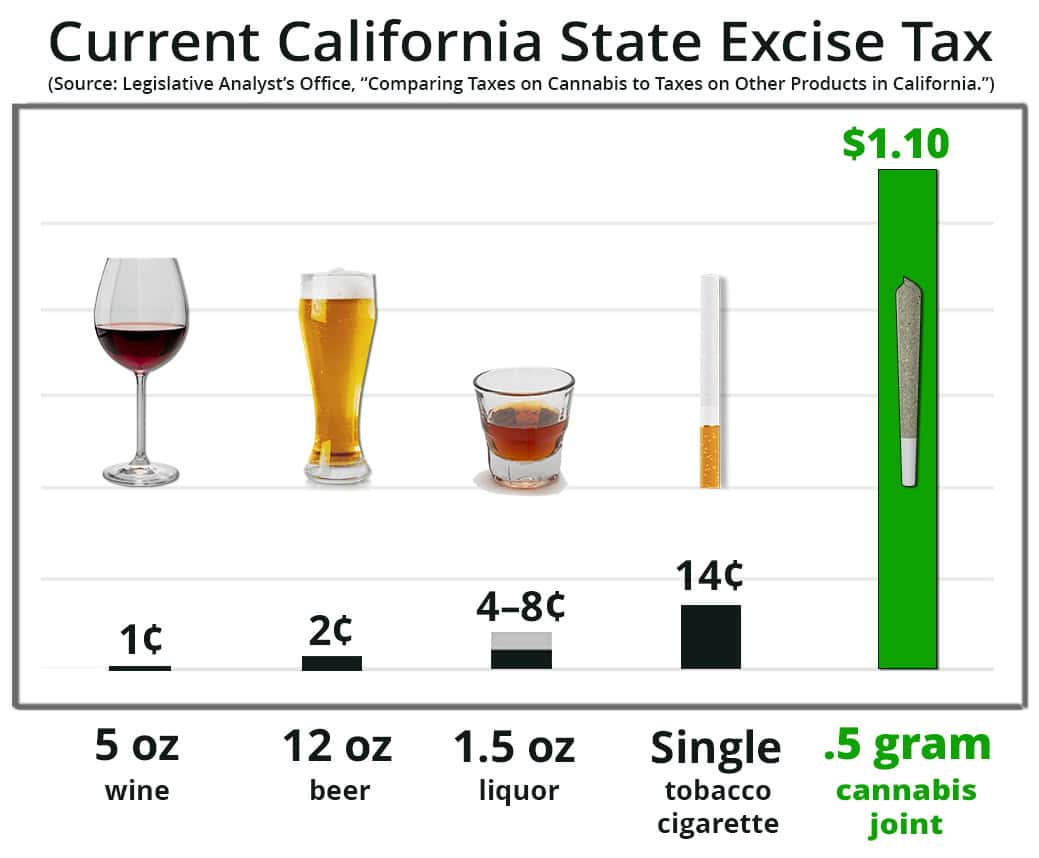
The folks behind California’s cannabis legalization bill, for example, got the bright idea to impose both cultivation taxes and excise taxes on the industry. This is on top of the state’s normal sales tax, which has a baseline of 7.25% of the sale price – subject to increases under city/county ordinances. Before the cultivation tax was eventually eliminated, it effectively was $161 per pound! As we sit here today, the excise tax is 15% of the sales price. Here’s a handy image from the folks at California NORML to illustrate how high the excise tax is:

Credit: Here

The above is just excise tax, to be clear. For any sale of cannabis, the excise and sales taxes alone will amount to at least 22.5%. That’s $22.50 on a $100 bill in just state cannabis taxation. A piece of proposed California legislation would have attempted to streamline some of the state level taxes to avoid double taxation, but it looks like the bill won’t advance much further. This is pretty terrible news during the midst of a literal crisis within the state’s cannabis industry.

Local cannabis taxation – just when you thought it couldn’t get any worse

In California, cities often tax cannabis businesses by their gross receipts. That means that if they generate $1mm in revenue, they will be taxed some percentage of that revenue. Sometimes the tax depends on the type of activity at issue and can fluctuate across the state, so this is a bit of an oversimplification. But we’ve seen cannabis taxes as high as 10% of gross receipts. That means that for $1mm gross receipts taxable at that rate, $100,000 would be paid as just the city’s gross receipts tax. This doesn’t factor in the state tax (hence the need for the failed bill mentioned above). Nor does it include 280E. We’re now talking about paying taxes on taxes.

What this looks like in practice

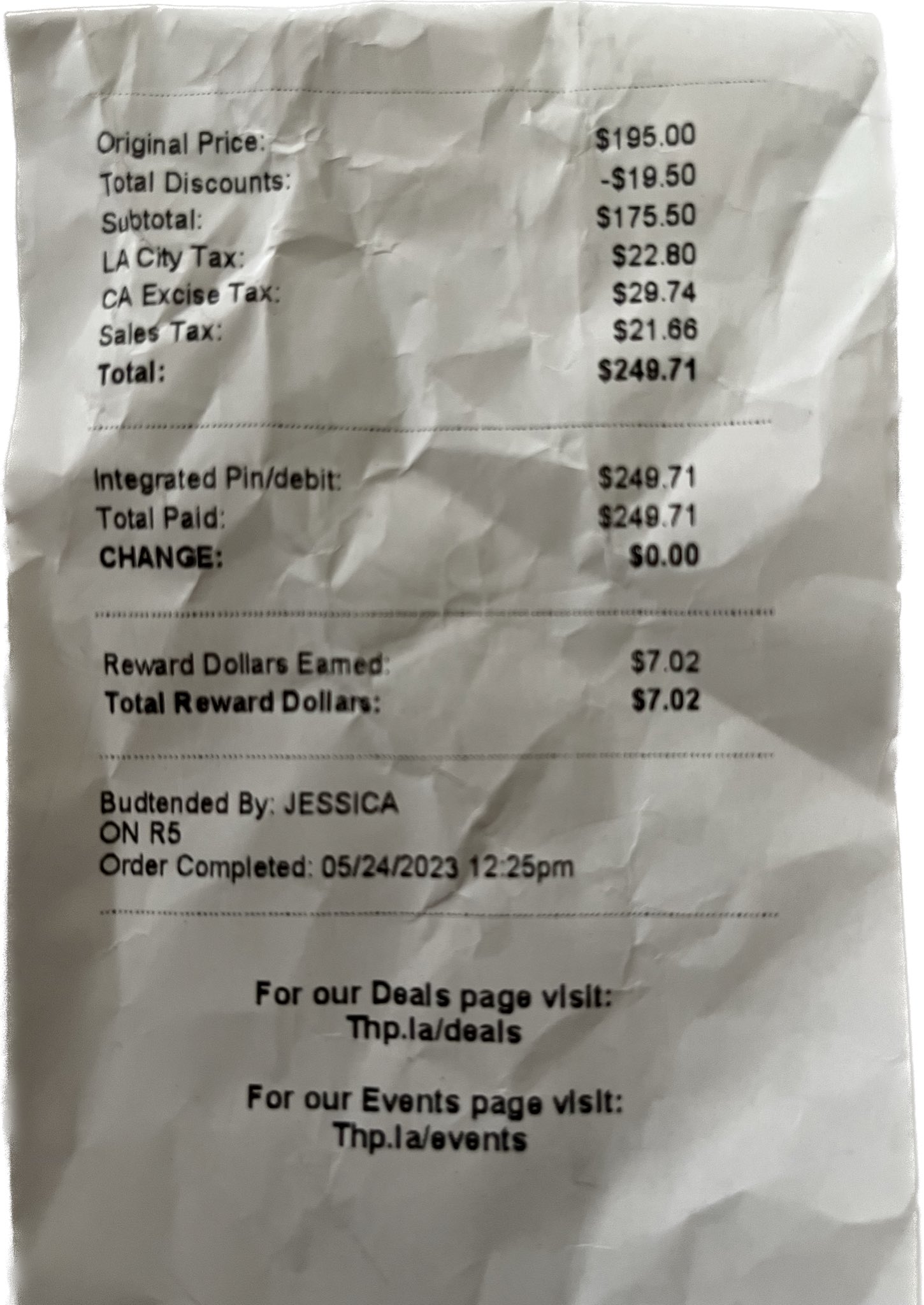
This following image of a cannabis receipt for a purchase in Los Angeles has made the rounds on Twitter in the last few months:

Image

Credit: @jgriesler

Let’s think about this a bit. On a purchase price of $175.50 (accounting for a discount), the total after tax is $249.71. That means that the tax was more than $74. That is a tax rate of more than 42%.

To be clear, these are costs that are charged to a consumer. This means that if the same consumer were to buy the same amount of cannabis (in terms of value) from the illegal market, they would pay about $74 less. If they were to buy some kind of highly intoxicating cannabinoid product (which they could probably do via e-commerce without getting out of bed), they would pay about $74 less.


Is it any wonder why the illegal market is doing so well while established cannabis businesses are falling by the wayside and going into insolvency? If the federal government truly cared about the cannabis market – a market that employs hundreds of thousands of Americans – it could solve this problem in five minutes. Even states have the power to cut out the shenanigans and take the pressure off the industry.

Cannabis taxes are too damn high. And until the problem is solved, don’t be surprised when the industry falls to pieces.

The post Cannabis Taxation is Theft appeared first on Harris Bricken Sliwoski LLP.


from Canna Law Blog™ https://ift.tt/4sntNfm
via IFTTT

Friday, July 14, 2023

The best cannabis seed companies 2023

See our list of the best cannabis seed companies 2023. Find quality seeds you can count on with this roundup of some of our favorite banks.

The post The best cannabis seed companies 2023 appeared first on Leafly.


from Leafly https://ift.tt/xz20wbc
via IFTTT

Science chat: Dissecting the new study on cannabis abuse and depression

Correlation is not causation. And detection bias is real.

The post Science chat: Dissecting the new study on cannabis abuse and depression appeared first on Leafly.


from Leafly https://ift.tt/AjfqdZt
via IFTTT

FDA and FTC Target Delta-8 Products

On July 5, 2023, the FDA and FTC jointly announced six cease and desist letters to alleged delta-8 product makers. You can access the letters here. Unlike prior rounds of warning letters, these letters have a new focus: harm to children.

For nearly five years, the FDA and FTC have taken the position that CBD is an unlawful additive in ingestible products. This is based largely on the so-called drug exclusion rule, which we’ve analyzed at length before (see here, for example). Essentially, because CBD is an approved drug ingredient (in Epidiolex®), it cannot be added to foods or dietary supplements.

Delta-8, however, is not an approved drug ingredient. And if it is derived from hemp, it is not independently scheduled – at least if you read the Controlled Substances Act and 2018 Farm Bill literally. But, there’s a huge controversy about whether it can be controlled, with agencies like the DEA saying it is. You can read more about that issue here or here.

But the fact that delta-8 products are in a gray area doesn’t mean the federal government’s just going to let things slide. Indeed, the FDA maintains a web page warning about the supposed dangers of delta-8 products. Knowing this, we could see that it was only a matter of time until the FDA started going after the industry.

This newest round of cease and desist letters takes an interesting turn, however. Many CBD warning letters alleged adulteration or unapproved drug concerns. These letters generally make similar allegations about adulteration. But they also claim that the products at issue are illegal because they constitute unfair or deceptive marketing. The problem: they all allegedly look like consumer foods and candies that are widely available to children. For example, here’s a blurb from one of the letters:

As noted above, your various Delta-8 THC products have an appearance and form similar to conventional candies, foods, and beverages often consumed by children. For instance, your Delta-8 Sour Gushers product is marketed in packaging that strongly resembles the packaging for Super Sour Gushers fruit snacks, including: a yellow background; brightly-colored design elements evoking liquid splotches, including green elements at the top and bottom; and the depiction of several individual fruit snacks, including a red fruit snack gushing red liquid beneath the word “Gushers.” Your Delta-8 THC Hot Cheetos are marketed in packaging that resembles the packaging for Cheetos Crunchy Xxtra Flamin’ Hot Cheese Flavored Snacks, using the same black and orange color scheme, the use of the Cheetos name and logo, and a depiction of flames at the top and bottom of the package. Your Medicated Jolly Rancher Gummies Sour are marketed in packaging that resembles the packaging of Jolly Rancher Gummies candies and Jolly Rancher Gummies Sour candies, including the use of a blue background, the use of the Jolly Rancher Gummies name and logo, and the cartoon depiction of anthropomorphic fruits.

Imitating non-THC-containing food products often consumed by children through the use of advertising or labeling is misleading. FTC Policy Statement on Deception, 103 F.T.C. 174, 176 n.9 (1984) (appended to Cliffdale Assocs., Inc., 103 F.T.C. 110 (1984)) (the nature, appearance, or intended use of a product may create an impression in the mind of the consumer, and it is deceptive if this impression is false and not corrected by the seller); 15 U.S.C. §§ 52, 55(a)(1) (under Section 12 of the FTC Act, which prohibits false advertisements for foods and drugs, the Commission must consider any consequences that may result from the use of the product under customary or usual conditions).

Children are at particular risk for mistakenly ingesting edible THC products imitating traditional foods because they are more likely to focus on similarities of product appearance and packaging, and less likely to notice or be able to comprehend labeling text. Ingesting edible cannabis products can result in serious health consequences in children.3 Given the significant number of adverse events reported in connection with ingestion of edible products containing THC, advertising and packaging your Delta-8 THC products in a manner that is likely to be particularly appealing to young children could present an unwarranted risk to health and safety.

It bears mentioning that the statements in the FTC and FDA’s cease and desist letter are just allegations. In any enforcement proceeding, the agency would have to establish that the recipient of the letter made the offending products and that they were illegal.

You may be asking what the lesson is here. For years the agencies targeted products based on health-related claims. Now they are expanding their focus, targeting products that may be marketed in other ways the agencies deem offensive. For years, this has been largely left to private plaintiffs in the form of IP claims (see here and here, for example). But it looks like the feds will now take a harder look at delta-8 products that they think kids may confuse for commercial candy or foods.

For now, stay tuned to the Canna Law Blog for more updates on FDA and FTC cannabinoid policies and delta-8 products.

The post FDA and FTC Target Delta-8 Products appeared first on Harris Bricken Sliwoski LLP.


from Canna Law Blog™ https://ift.tt/1JDWNjQ
via IFTTT