This spring, the focus is on fresh, innovative formats that fit seamlessly into an active lifestyle.
The post Spectacular delta-9 and kratom deals for spring appeared first on Leafly.
from Leafly https://ift.tt/PsZD93w
via IFTTT
This spring, the focus is on fresh, innovative formats that fit seamlessly into an active lifestyle.
The post Spectacular delta-9 and kratom deals for spring appeared first on Leafly.
Most commentary on the “hemp ban” included in the November funding bill has focused on two related questions: (1) which products and activities may become unlawful on November 12, 2026; and (2) whether Congress will materially amend or delay the ban before then.
I recently discussed another consequence operators should be considering as the deadline approaches: bankruptcy eligibility. But focusing only on insolvency planning misses a much more immediate operational problem: inventory.
Many hemp operators are currently holding large volumes of unsold material. At the same time, portions of the domestic cannabinoid manufacturing sector are already contracting. Some manufacturers are shutting down, others are reducing intake, and many are unlikely to purchase new raw material as November approaches. The closer we get to November without any change or extension to the law, the more unsold inventory will be at risk of destruction rather than sale. The predictable result is that a significant amount of compliant hemp may have no viable domestic buyer before the legal landscape changes.
There is, however, a potential solution receiving far less attention than it should: exporting that material to markets where demand still exists.
The November 12 deadline is not just a regulatory change. It is a market-structure event.
If the law takes effect as written, hemp plant material exceeding the new statutory threshold of 0.4 mg of total THC will effectively become unlawful to transport across state lines. In addition, operators in states without a closed-loop internal (intrastate) hemp market may be unable to participate in local commerce at all. Even for material cultivated lawfully beforehand, downstream purchasers will not want to hold inventory that may soon become legally risky to process, store, transport, or resell. Businesses operating in states without intrastate markets will be particularly exposed, and even robust state markets are likely to prioritize in-state sourcing to ensure supply stability after November 12.
Recent reporting that Chicago’s United Center has begun selling Señorita and RYTHM hemp-derived THC beverages at certain events illustrates the point. Those products are associated with Illinois cannabis operator, Green Thumb Industries, and their production and distribution appears structured to occur entirely within a single state. As long as Illinois and local law remain unchanged, those beverages can continue to be sold because no interstate transport is required (assuming no other applicable federal law will prohibit sales at the United Center). Opportunities like these will only be available to cultivators and producers that operate in states with intoxicating hemp programs. Those that operate in states that prohibit such products won’t be so lucky.
For operators whose business model depends on interstate distribution, this creates a classic end-of-regulatory-cycle dynamic:
In other words, the problem for many operators will not be compliance but liquidity. Starting material that was lawful to grow may simply become commercially stranded.
Unlike the rapidly changing U.S. consumable hemp market, many European Union jurisdictions regulate hemp differently. Several EU countries permit the importation of raw hemp plant material. Once imported, goods may circulate within the EU and, in some cases, move into non-EU markets such as the United Kingdom.
These markets often value U.S. hemp for consistency and production scale. As domestic U.S. demand contracts, lawful foreign demand may still exist, but primarily for certain categories of raw material.
This strategy is narrow and operators should understand its boundaries.
It also does not address exporting THCa plant material. That presents a separate and substantially higher-risk legal analysis involving both U.S. enforcement interpretation and destination-country controlled-substance law.
The discussion here concerns exporting raw agricultural hemp material, not cannabinoid consumer products.
The operational point is straightforward: the legal window may close before many operators act. After November 12, exporting hemp plant material that no longer qualifies as federally lawful hemp will become unlawful, even if the crop was cultivated prior to the deadline. Once the material is treated as non-compliant cannabis under federal law, cross-border shipment, even between U.S. states, becomes problematic simultaneously under federal controlled substances law, customs export procedures, carrier policies, and foreign import certification requirements.
At that stage, inventory may not merely be unsellable but effectively immovable.
The industry has been treating November 12 primarily as a future compliance date. For many operators, it is more accurately a sales deadline.
If, by late summer or early fall, domestic processors shift to in-state sourcing or stop purchasing raw material altogether, cultivators may be left holding product that was lawful when grown but has no viable domestic buyer before the regulatory change takes effect.
Exporting to the EU or other countries may therefore function as a bridge strategy – a way to monetize inventory that might otherwise go unsold. Unlike restructuring strategies, this approach cannot wait for legislative certainty. Exporting agricultural material requires documentation, phytosanitary compliance, logistics planning, import-country regulatory verification, customs coordination, and buyers. Each step requires lead time, and the regulatory deadline is fixed.
Congress may amend the law, delay implementation, or do nothing. Operators should not base operational strategy on legislative uncertainty. If the deadline remains, the purchasing slowdown will likely begin well before November 12, meaning the practical deadline for selling inventory may arrive months earlier.
For some hemp businesses, the question is no longer simply whether they can remain compliant after November. It is whether they can convert existing inventory into revenue before the market disappears.
If you interested in learning more about exporting hemp material, corporate structuring, regulatory compliance, or evaluating how the November 12 deadline may affect your operations, please contact me to discuss your specific situation.
The post What the 2026 Federal Hemp Ban Means for Unsold Hemp Inventory appeared first on Harris Sliwoski LLP.
Talk a walk through the hall of fame with our look back at past Leafly Strain of the Year winners. This year's winner is announced March 4th.
The post A look back at the Leafly Strain of the Year hall of fame appeared first on Leafly.
In the last year or two, we have seen a growing number of marijuana businesses take the position that IRC 280E no longer applies to them. Some of these businesses have taken that position in consultation with lawyers and CPAs. This shift in strategy predates Trump’s Executive Order of December 18, 2025, to reschedule marijuana under the federal Controlled Substances Act (CSA). In any case, I believe this is a misreading of the law and a dangerous position for these businesses to take.
IRC 280E is a federal tax provision that prohibits businesses engaged in the “trafficking” of Schedule I or Schedule II controlled substances from deducting ordinary and necessary business expenses on their federal tax returns. This rule applies to state-legal marijuana businesses, and it forces many of them to pay federal income tax on gross income (revenue minus cost of goods sold) rather than net income (profit). It’s harder on some businesses than others, but overall IRC 280E is a scourge for any marijuana taxpayer.
Yes, cannabis businesses have challenged the law repeatedly over the past decade or so, on constitutional and “as applied” grounds. We have supported those efforts, including in litigation brought by clients of this law firm. Still, I’ve explained that “except for Champ v. Commissioner, no cannabis taxpayer has won an IRC 280E case (and there have been a bunch of them).”
I stand by the statement, while acknowledging that parties have achieved limited successes via COGS adjustments and refund requests. Overall, though, courts have consistently upheld the validity of IRC 280E as applied to marijuana businesses, and they have cast aside every constitutional challenge to date. It’s just a very difficult situation.
The current litigation to watch is a tax court case known as New Mexico Top Organics, Inc. d/b/a Ultra Health v. Commissioner (“NMTO”), filed last October. The primary argument is that marijuana is no longer “within the meaning” of Schedule I of the CSA, despite being listed there. The case relies on a 2023 determination by the Department of Health and Human Services (HHS) that marijuana should be placed in Schedule III. It also relies on Congressional spending bills, and finally, on the proposed rescheduling that began under President Biden.
I don’t find the arguments persuasive. Without analyzing the merits, though, it’s important to note that the NMTO plaintiff is a medical marijuana business. The plaintiff is not arguing that IRC 280E doesn’t apply to generalized adult-use sales (which are most sales nationwide, at this point). It’s also important to note that any decision by the tax court could be appealed by either party to the Tenth Circuit, and a ruling likely would not grant immediate relief to anyone–let alone non-litigants.
I’d like to think that most of advice is along the lines of what we tell our clients, viz. that marijuana is still a Schedule I controlled substance, unfortunately, and IRC 280E still applies. And I think that is what a clear majority of attorneys and CPAs are saying. That said, we’ve seen outlying and aggressive advice from professionals on whether marijuana businesses are still subject to IRC 280E, and even on whether marijuana remains in Schedule I (it does). Here’s a prominent example:
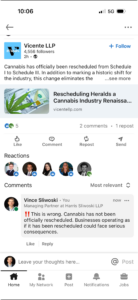
I’m not sure what the law firm there was thinking, and to be fair, they deleted the post following my comment. On the CPA side, the position I first vetted last year parrots the arguments in NMTO. The CPA I spoke with argued that marijuana is no longer “within the meaning of Schedule I” (despite its placement there), and that NMTO’s arguments apply equally to income from adult-use sales. The kindest thing I can say, euphemistically, is that it’s an interesting position.
In June of 2024, following the HHS recommendation that marijuana be moved to Schedule III, the IRS published a memo titled “Marijuana remains a Schedule I controlled substance; IRC 280E still applies.” The Service stated that this would be true “until a final federal rule is published.” That never happened under the Biden administration’s flawed rescheduling process, and still hasn’t occurred following Trump’s executive order.
For good measure, the IRS followed on its memo six months later with another straight-ahead publication, observing that “some taxpayers have taken the position of disregarding the section 280E limitation using a variety of rationales that do not constitute reasonable basis.” The term “reasonable basis” is a relatively high standard of tax reporting (see 26 CFR 1.6662-3(b)(3)), and a myriad of penalties may ensue where the standard is not met. Straight talk.
For its part, Congress has failed to pass legislation to nullify the effects of IRC 280E, and every bill to de- or reschedule marijuana has ultimately failed. However, the Congressional Research Service, which I like, issued relevant guidance on IRC 280E earlier this month. The February 6 report is titled: “The Application of Internal Revenue Code Section 280E: Selected Legal Issues.” Notwithstanding the IRS publications discussed above, the CRS report maintains there is “little tax guidance concerning the application of Section 280E.” It then discusses a series of proposals that, if enacted, “would no longer prohibit marijuana businesses from taking deductions and credits.” In other words, without the enactment of any of these proposals, IRC 280E still applies.
I’m sure any business paying tax on gross receipts would love to enjoy the same deductions as other U.S. taxpayers. For this reason, and because certain advisors have jumped the shark with rescheduling in the air, we’ve seen more cannabis businesses filing returns that ignore IRC 280E. We’ve also had clients file amended returns seeking refunds for taxes paid under the IRC 280E regime, contrary to IRS warnings (not to give anyone any ideas!). Some of these refunds have been processed, and our best advice is “set that cash aside, at least through the audit window.”
Let’s hope the rules change for tax year 2026, and that the Department of Justice picks up the ball with President Trump’s rescheduling order. Specifically, let’s hope for a final rule, or better. For now, though, I believe the correct advice is that IRC 280E still applies to marijuana businesses. Unfortunately.
The post IRC 280E Still Applies to Your Marijuana Business, Unfortunately appeared first on Harris Sliwoski LLP.
The New York Times has published a poorly researched, misleading op-ed on the cannabis industry and the effects of legalization. Read our response.
The post WTF is The New York Times’ problem? appeared first on Leafly.
Oregon’s 2026 legislative session began last week on February 2. The biennial “short session” will last but 35 days, and focus on budget shortfalls, transportation and housing—which is to say that cannabis is not a priority. That said, of the 300 or so introduced bills, there four cannabis-related submissions. That’s where I come in.
Each bill is linked below, with explanation and editorial.
This is the annual omnibus cannabis bill. My source tells me it collapsed a few weeks ago when marijuana and hemp folks couldn’t agree on core items around intoxicating hemp products, or on how to implement the new federal hemp laws and rules. That’s unfortunate, because time is of the essence in any short session.
At this point, HB 4139 has been kicked to an interim working group driven by the Governor’s office and the Cannabis Industry Association of Oregon (CIAO). They met yesterday at 1 p.m., apparently.
Here’s what the bill would do in its introduced form, with a few comments by me:
This is a medical marijuana bill, focused on patients and caregivers. I’m told it has traction and a work session meeting tomorrow. Here are the salient provisions:
This doofus bill was brought by the United Food and Commercial Workers Local 555, who are trying to get their own initiative repealed. My guess is UFCW is doing this because the U.S. District Court ruled that the initiated law is unconstitutional, as predicted, and they don’t want “more bad law” when the Ninth Circuit upholds that ruling.
I’ve written lots about the waste of taxpayer money the Ballot Measure 119 saga represents. See here, here, here, here, here, here, here, here and here. In short, BM 119 required most Oregon cannabis businesses to enter into labor peace agreements with “approved unions”, in order to renew or obtain licensure. On May 20th, the Oregon District Court struck it down. The case is up on appeal, but HB 4162 could quietly moot that, if passed.
In all, HB 4162 is tantamount to the Union saying “hey legislature, please repeal this law that you warned us would be legally deficient, but which we convinced voters to approve directly regardless. We will stop wasting taxpayer money if you help us overrule ourselves. (At least for now.)”
This is a public health and prevention bill brought by the Chair of the Senate Behavioral Health Committee. I’m told the hearing on Monday was contentious as between that side of the aisle, and industry. Here are the key provisions:
I’ll check back at the end of the session and report on what has passed, if anything. Aside from the farcical HB 4162, anything that gets through will likely look markedly different in final form than the enrolled drafts we see today.
The post Oregon Cannabis 2026: Legislative Forecast and Report appeared first on Harris Sliwoski LLP.
Earlier this month, the Bailiwick of Jersey appeared poised to take a measured, evidence-based step toward re-examining its approach to non-medical cannabis. Three reform proposals put forward by Tom Binet, Minister for Health and Social Services, were expected to be debated by the States Assembly of Jersey on February 3, 2026.
That debate has now been canceled and deferred until, at least, after the June election.
While postponements around elections happen, the decision is nonetheless disappointing. The proposals were expressly designed to be cautious, incremental, and compliant with international obligations. Their removal from the Assembly agenda suggests that short-term political considerations have, for now, outweighed a substantive discussion about public health, criminal justice efficiency, and regulatory realism.
The proposals arose from a June 2024 Assembly decision directing the Council of Ministers to explore potential approaches to decriminalization, legislation, and regulation of non-medical cannabis. That mandate reflected a recognition that Jersey’s current framework—rooted primarily in criminal enforcement—may no longer align with contemporary evidence or policy outcomes.
Importantly, none of the options would have resulted in immediate legal change. Approval of any proposal would merely have authorized further research, consultation, and policy development, followed by additional Assembly debate and Attorney General review.
In that context, the cancellation of the debate is not just a procedural delay; it is a missed opportunity to engage in a fact-based discussion about reform options that were deliberately modest in scope.
When the issue returns to the Assembly, if it does, members may again be asked to consider three non-exclusive, high-level options.
Under this approach, possession, cultivation, and social supply of cannabis would remain criminal offences, but prosecution would cease for personal possession and associated cultivation of small quantities, subject to indicative thresholds. Personal cannabis use would be treated as a public health issue, shifting lower-level offences from a prosecutorial model to harm reduction and prevention strategies. This option represents the most conservative form of reform and is explicitly permitted under international drug control treaties.
This option would go a step further by removing criminal liability entirely for possession or cultivation of small quantities within defined limits. Cannabis use would remain limited to personal use, and commercial supply would continue to be criminalized.
Decriminalization of this kind is no longer novel. Comparable frameworks already operate across several European jurisdictions and have not resulted in the negative outcomes often cited by opponents.
The most ambitious proposal, though still modest to some, would authorize a tightly regulated, government-controlled pilot program for the production and sale of non-medical cannabis.
Participation would be limited to registered Jersey residents, with strict controls on access, quantity, and distribution. Activity outside the pilot would remain criminal. The purpose of the program would be empirical: to assess whether regulated access can improve public-health outcomes without increasing harm or diversion.
Assembly members could, of course, reject all three options and maintain the status quo.
According to reporting by Bailiwick Express, the scheduled Assembly debate was canceled outright and will not be revisited until after the election. While this may be politically expedient, it is difficult to avoid the conclusion that electoral caution has taken precedence over common-sense policy evaluation.
None of the proposals required Assembly members to endorse legalization. None committed Jersey to a commercial market. All were designed to gather evidence, reduce unnecessary criminalization, and align enforcement with public-health realities. Postponing even that discussion underscores how cannabis policy continues to be treated as politically radioactive, despite decades of data suggesting that prohibition-first approaches are ineffective.
The United Kingdom remains a central constraint. As the internationally responsible state, the UK’s view is decisive if any proposal advances toward legislation.
Past experience, most notably the UK’s refusal to grant Royal Assent to Bermuda’s adult-use legalization bill, demonstrates the limits of Crown Dependency autonomy in this area. That history is precisely why Jersey’s proposals were incremental rather than sweeping.
Option one relies on enforcement discretion expressly allowed under the 1988 UN Convention. Option two mirrors decriminalization regimes already functioning in Europe. Option three aligns with tightly controlled adult-use pilot programs in Switzerland and the Netherlands, and a similar program authorized (but likely not to be implemented) in Germany as part of its phased cannabis reforms.
In other words, these proposals were crafted to survive scrutiny. Delaying their consideration does not resolve the UK issue; it simply postpones a conversation that will eventually have to occur.
The cancellation of the Assembly debate is not a rejection of cannabis reform, but it is a clear signal that politics, not policy, has prevailed for now. That outcome is disappointing, particularly given the restraint and evidence-based nature of the proposals on the table.
When the election concludes, the next Assembly will face the same underlying realities: ongoing criminalization of low-level cannabis conduct, enforcement costs with limited public-safety benefit, and growing divergence between Jersey’s law and modern regulatory approaches elsewhere.
Whether the next Assembly chooses to confront those issues remains to be seen. What is clear is that common-sense cannabis reform has been delayed—not because the proposals were unsound, but because the timing was politically inconvenient.
The post Jersey (Territory) Cannabis Reform Proposals: What Could Have Been, and What May Be–After The Election appeared first on Harris Sliwoski LLP.
Leafly Picks editors selected the best weed products for Valentine's Day 2026 to help you infuse the holiday with canna-friendly romance.
The post The best weed products for Valentine’s Day 2026 appeared first on Leafly.
Last month, we hosted a webinar on federal cannabis law and policy in 2026. While things are not where we’d like them to be, it’s amazing to consider everything that has happened over the years. From a lawyering perspective, it’s almost unbelievable.
I have worked as a business lawyer in the cannabis industry for over 15 years. It’s been a long, strange trip as the poet said. And I’m grateful for it. Below is a long-form piece on how it all went down.
I was a second-year lawyer at a business firm downtown when a medical marijuana dispensary owner came through our office. (Back then, nobody said “cannabis.”) His shop was here in Portland, with a grow in the back, and the owner had been passed along by two other law firms that felt uncomfortable advising him. This gentleman had received a bankruptcy trustee’s notice on his door, advising that his landlord was in a Chapter 7 (I think). He desperately wanted to stay in the building. Maybe even buy it, somehow.
We looked at the lawyer ethics rules, called the state bar association, read the Ogden memo, etc., and it was unclear whether we could assist the client—even regarding compliance with state and local laws. It was unclear whether our malpractice insurance extended coverage. It was unclear whether our bank would take the deposits. It was unclear if his business even complied with Oregon law to begin with. Everything was unclear; no one would opine. The first Cole memo issued that summer, making things even more confusing. But, the answers were not clearly “no” and my boss invited me to try. I had no problem with any of it.
I ended up helping the client reach a deal to pay cash rent to the Trustee—which would never happen at this point: the payment part is wild; the cash protocol, outrageous—and then I started helping him with business agreements and everything else. Back then, there were virtually no lawyers working on non-criminal cannabis issues. He started sending me industry referrals, one after another. It was a crazy time—the work was less sophisticated but also more challenging in some respects than much of what we do today.
Seems like all of those people are gone now.
Oregon was not licensing medical marijuana dispensaries, but people were boldly opening collective-style storefronts, like the guy I just mentioned, ostensibly under the state’s decades-old medical marijuana statute. That law was not designed for commerce, at all. The policy idea was to simply to confer an affirmative defense to “patients” and “caregivers” from prosecution under state law for cannabis possession and use. That’s as far as it went.
A lot of the businesses I dealt with in those days had self-organized as non-profits and collectives and such, as borrowed from the California model. I couldn’t find accountants for them, or anything really. It was such a mess.
That fall, Oregon’s Measure 80 narrowly lost at the polls, 47% to 53%, while Colorado and Washington passed legalization measures. Measure 80 would have legalized cannabis for adult use statewide in Oregon, established a licensing and taxation system, etc.—which ultimately happened a few years later under Measure 91. Elsewhere, industry pioneers like California’s Harborside dispensary (who would later become a client; then go public; then fail) were going at it with the feds. In those days, everything was a rock fight.
The Oregon legislature passed a law called HB 3460 that August, directing the Oregon Health Authority (OHA) to write rules and launch a registry system for medical marijuana operators. This was a big deal! Clients seemed nervous: there was no industry lobby to speak of, and everything coming from Salem seemed reactive.
The second Cole Memo also issued that summer, in response to the pending Washington and Colorado adult use programs. It felt like things were changing pretty fast. My boutique business law firm “merged” with a mid-sized law firm downtown that catered to financial institutions and did not like cannabis. I continued to quietly do the work. A lot of that work was unsupervised; somehow it all worked out.
OHA issued its rules, which were skeletal, unenforced and ass-backwards on certain things. There were no cannabis testing requirements; no grandfathering protections for current storefront operators; a rule that people who had been convicted for “manufacture or delivery of [cannabis]” couldn’t be “responsible for” a cannabis store (?!); and I can’t even remember what else. But I recall clients coming to us with so many questions and problems which were essentially unanswerable, because the framework wasn’t there. That November, Measure 91 passed, legalizing cannabis for adult use in Oregon. Finally.
On the federal side, the Department of the Treasury issued the FinCen Memo on “BSA Expectations Regarding Marijuana-Related Businesses.” This was accompanied by another DOJ memo titled Guidance Regarding Marijuana Related Financial Crimes, and a DOJ memo on “Marijuana Issues in Indian Country.” The latter two directives were rescinded four years later by Attorney General Jeff Sessions, but the FinCen Memo is somehow still in effect. More than a decade later, I would find myself advising banks, credit unions and even the federal government on that cumbersome guidance.
The Oregon legislature started messing with Measure 91 almost immediately in drastic ways (e.g. tax structure, residency requirement). Some of my clients started to ramp up to transition into the OLCC program, but many sat back and waited. People were getting bigger and bolder on the medical side. We began to see a proliferation of medical marijuana processors and “wholesalers” around this time, although none of this was contemplated in the rules. Lots of crazy stories.
The Oregon State Supreme Court amended the attorney ethics rules in February, to expressly allow us lawyers to work with marijuana business “regarding Oregon’s marijuana-related laws.” Most lawyers remained on the sidelines, though. I left my old firm in June, and started the Portland office of what would become Harris Sliwoski LLP. A lot of people seemed to think that was a crazy move, but it was really fun. I started writing intensively here on the blog and I wrote the first of 100 columns for the Portland Mercury. I stopped doing litigation entirely.
Adult use and possession became legal on July 1, which was awkward in the sense that OLCC had not yet licensed stores. The state eventually capitulated and allowed early sales through existing medical dispensaries on October 1. The whole system was still vexing from a contracts perspective—the cannabis being bought and sold all came in through the OHA supply chain, which meant it was theoretically the property of medical marijuana patients, at least to start.
I worked with another lawyer in my firm on one of the OLCC rules advisory committees, and the first batch of the OLCC program rules dropped in October of 2015. The Commission made a valiant effort there, but business acumen was lacking. The “financial interest” and “residency” rules were terribly confusing, and basic commercial concepts were not addressed, from convertible notes to security interests. The City of Portland was even worse.
Folks started lining up to submit OLCC applications on January 1, 2016. I recall organizing and incorporating a dizzying number of little companies in the months leading up to that date. Back then, a common setup was someone with property, a guy who knew how to grow cannabis (always a guy), and maybe an investor with $200,000 or so. Really simple stuff. I testified before various cities and counties with respect to cannabis-related zoning ordinance proposals. Some of those hearings were well-run and respectful; a few went off the rails.
We muddled through licensing and the system began to launch. I recall one of our producer (grow) clients being told they were the “third licensee in the state.” The legislature began to fiddle with the system further, including through repeal of the residency requirement (HB 4014). It’s hard to overstate how important this was: no other jurisdiction in the world had a cannabis program where non-residents could be owners. Calls started coming in from everywhere and people could not seem to get their minds around it. But the rules were clear: you could be from Oregon or California or Israel or Spain. You could be from Mars.
We answered a lot of questions about federal law enforcement back then, which hardly happens anymore. The fear factor ticked up substantially again in November, when Donald Trump was elected President. That same election night, California, Nevada, Maine and Massachusetts all went recreational (and Arkansas, Florida and North Dakota all adopted medical programs), making the state/federal dynamic more dissonant than ever. Locally, more and more OHA program participants made their way into the OLCC system, while others stayed put or went off the grid altogether.
OHA finally got its act together and started licensing medical marijuana processors, even though the medical program was clearly on the way out. The Oregon Department of Agriculture (ODA) passed a key law to propel the stalled state hemp program, and we had a few clients start in on that. They had logistical problems you wouldn’t believe, including finding seeds.
Jeff Sessions was confirmed as Attorney General to kick off the year. People will say that didn’t scare anyone, but I’m here to tell you that investment slowed a bit. By mid-year, though, the OLCC program began to hit its stride. Things felt mostly “built” for the first time, even if a testing lab bottleneck persisted, with other program kinks.
By December 2017, there were almost 900 licensed farms in Oregon, and the M&A market started to gain steam. There was a lot of press at this point about oversupply, unlicensed cannabis and diversion. The faddish and wasteful RICO lawsuits were in full swing. Here at the law firm, we were also fielding fewer calls from “medical marijuana growers,” although it was known that folks were still stacking cards and everything else. That said, all of those 90-plant medical grows were going the way of the buffalo.
Elsewhere, many of the newer businesses were already failing and folks started suing one another in earnest. Reporters still called whenever lawsuits were filed. I recall posting ads for litigators, and wondering if OLCC licensees would figure out how to make money in the regulated market. I also sat for a series of lunches with lawyers in mid-sized and large law firms who were poking around the Oregon space. Finally, I took a few calls from the FBI and U.S. Attorneys on client-related investigations. Not great.
On the hemp side, we saw more and more clients pursuing CBD sales, which were coming into vogue notwithstanding confusion about the 2014 Farm Bill and everything else. Under Oregon’s pilot program people got crops in the ground, however. And with federal discussion looming, it felt like hemp was finally on the way.
Elsewhere, I became an owner at the law firm on January 1, and we opened offices in San Francisco and Los Angeles, which were highly productive for a time. That summer, I was cynically sued in circuit court for “civil conspiracy” by a poorly supervised colleague at a large law firm. The allegations were based on advice he assumed I’d given to a cannabis client. That claim went nowhere.
I began teaching a Cannabis Law & Policy course in the fall, which continued over a five-year period. We had Earl Blumenauer come speak and things like that. In 2017, it was the second or third such class on offer nationwide. Class was sold out and then some.
Jeff Sessions kicked off the year by rescinding the Cole Memo, which got people jittery once again. The local “oversupply” conversation was coming to a head, such that Oregon U.S. Attorney Billy Williams felt the need to author a memo of his own. Immediately thereafter, the OLCC “paused” its intake of marijuana license applications—possibly as a result of the memo, but also because the Commission was just so far behind.
The Canadian invasion was also in full swing at this point. Many of our local clients were rolling up on the Canadian Stock Exchange through reverse mergers, or wondering how to do this, or talking with someone about doing it. Other clients despised the whole thing. And still other clients WERE the Canadians. Foreign dollars were also pouring into other western states by this point, mostly California and Nevada.
I cannot tell you how many mergers, reverse mergers, option agreements, stock sale agreements, asset purchase agreements, convertible debt agreements, etc. etc. we papered around this time—even as prices tanked. It was incredibly dynamic and incredibly fast. Around this period, we also were hired by a series of large-cap, bellwether U.S. companies trying to understand the CBD market and what could be done there. Lots of opinion work, with corporate campus visits. We did a series of celebrity collabs, too; a few of those are still going strong.
Outside of Oregon, I doubt there was ever a bigger year for cannabis than 2018. California commenced its adult use marketplace, the U.S. legalized hemp through the 2018 Farm Bill and Michigan became the first midwestern state to go full rec. Internationally, Canada legalized marijuana federally, Mexico announced its plan to do the same, and the U.N. announced it would revisit cannabis scheduling. Oh, and Jeff Sessions was sent on down the road. It was awesome.
Hemp was probably the biggest story locally in 2019. Nearly 2,000 growers registered to plant over 63,000 acres, a nearly 6x acreage increase from the year prior. Then the problems came. Much of the hemp went unharvested due to bad weather and inexperience. Prices also fell through the floor along the supply chain, from seeds to finished products. Our office handled more litigation on the hemp side than on the THC side. And people started to use ODA licenses as cover for diversion, rather than persisting in the OHA (medical marijuana) system.
Federally, USDA seemed to slow walk the rules, and FDA was as useless as ever. The ODA’s adoption of a “total THC” testing standard was also hard for operators. Nationwide, the CBD craze was in full swing. Some of the country’s largest grocers, distributors and CPG companies hired us and flew us around, after buyers and marketing departments got ahead of themselves. The high point was being flown to D.C. and advising the National Credit Union Administration on guidance it issued for hemp banking.
On the THC side, the Oregon legislature finally passed a law to curtail the award of cannabis production licenses, bowing to pressure from all sides. It was too late to have much impact, although the effort did create a strong secondary market for producer license transfers (which we continue to trade in today). The legislature passed another forward-looking law to allow cannabis exports; the idea here was to set up local growers for the end of prohibition. Finally, vaping came into the regulatory crosshairs, resulting in more litigation.
2019 was the first year that the OLCC market seemed to really settle out and there was less compliance work than before. We had paralegals covering most of the licensing. Beyond that, it was just deals and deals and deals.
This was the first year that Oregon passed the $1 billion sales mark (cresting at $1.1 billion), driven by COVID-related factors. The pool of retail licensees continued to grow, but other license categories remained static. OLCC finally streamlined its application process to some extent, a theme the Commission would return to in future years. OLCC also adopted a short-lived “fix it or ticket” approach to certain rules violations, and enacted a ban on certain vape products.
We were still doing a lot of M&A work, most memorably for a private equity firm that swooped in to buy and operate expansive verticals; and which five years later, we put into receivership. Other clients plodded along; but with prices still low, it was a volume proposition up and down the supply chain. Overall, Oregon cannabis M&A really peaked around this time. We also saw renewed interest from tribes, including intergovernmental agreements between the Cow Creek Tribe and Oregon.
Wildfires were terrible in the fall, with one in every five licensed marijuana businesses (or 408 businesses) in evacuation protocols. A large number of producers were forced off site entirely. The fires hit the hemp grows hard too, as they were heavily concentrated in the affected areas. It was a terrible time for many outdoor hemp and marijuana licensees, many of whom lost crops and equipment, and were un- or underinsured.
Unlike the THC market, the hemp market continued to sputter. Biomass pricing hovered at $2.50 or less per pound, versus $40 to $45 just two years prior. We still had many litigations in the office arising from businesses failing and investors losing money. Some of the work also involved SBA lending issues and bankruptcy proceedings, which was novel in the cannabis space.
I had been writing about international cannabis on the blog for a while, and we had some interesting matters come through the office. One of them required us to register with DOJ under the Foreign Agents Registration Act; others involved battling Customs and Border Patrol on wrongly embargoed shipments. The firm was uniquely suited for all of that, with our international trade lawyers lending a hand. I felt I was learning a lot.
Finally, this was the year that Oregon’s Measure 109 and Measure 110 passed. I was somewhat critical of Measure 109, which created a cottage psilocybin services industry, and which we would advise on in coming years. Measure 110 decriminalized possession of all drugs in small amounts. That experiment faltered, though, and the legislature rolled it back four years later. They did leave in provisions that siphoned off marijuana tax revenue for addiction services.
Pricing and regulated marijuana sales plateaued in 2021, although the pool of licensed retailers continued to grow, from 719 to 760. The number of producers also increased from 1,177 to 1,388—which wasn’t needed at all. But OLCC’s streamlined licensing process was cutting through the backlog, following a very pregnant three-year “pause.” All in all, the industry continued to grow, despite a challenging labor market.
During this time, we helped people buy and sell producer licenses in the $250K – $300K range. A few years later, prices would fall as low as $30K. One of our clients liquidated something like 6 licenses on adjoining tax lots around this time; and though his timing was impeccable, he was arrested driving weed around Texas shortly thereafter. He went bust entirely. Anyway, many of the license buyers were Eastern European around this time; Chinese nationals were another sizable demographic and eventually moved into the lead.
“Artificially derived cannabinoids” were in the regulatory crosshairs, and OLCC was tasked with regulating these compounds. OLCC and ODA also got more enforcement funding, and launched Operation Table Rock. It targeted mostly southern Oregon grows, and predictably found a majority of licensed hemp producers growing marijuana. The legislature then met in a one-day special session to grant $25 million more to enforcement. I wrote that it “wouldn’t be enough,” and it wasn’t.
Certain administrative and criminal litigation ensued, though we didn’t have any of that here in the office. On the national level, the enshittification of hemp was well underway, with delta-8 and other intoxicating products being shipped nationwide under dubious color of law and with scant regulation. We decided as a law firm not to take that work, which means we decided to leave a lot of money on the table. I’m still good with that.
I got into a groove of taking on expert witness matters in state and federal court, which got me back to my litigation roots and was fun. I ended up testifying before a jury in one of them, and submitting a report for federal court use in another. All of these were disputes on the standard of care for lawyers in the cannabis space. Strikes and gutters as they say.
Some big names made the news in locally 2021. Dutchie, the cannabis Ecommerce platform out of Bend, raised an impressive $350 million in a closed Series D, at a $375 billion value. Curaleaf, which we later represented on international cannabis shipping, was sued up and down for selling a THC product in CBD packaging—among other things. And GoldenLeaf, the first Oregon cannabis outfit to roll up onto a Canadian stock exchange, came back from the dead to acquire five Home Grown Oregon stores.
We opened a New York office, which was fun and lasted a couple of years. I was also cited by U.S. Senators Cory Booker and Elizabeth Warren in correspondence to U.S. Attorney General Merrick Garland, regarding a plea to decriminalize cannabis.
But my favorite lawyering memory, ever, was being invited to speak for NORML down in Key West, Florida that December. After my presentation—but before we went for beers with a judge who had played himself in The Wire—I sat at a folding table in the back, next to an older gentleman. He was wearing a tank top and a Support the Troops cap. He said well done and shook my hand, and introduced himself as Phil Hirschkop. There was something about the interaction; I Googled him under the table; I damn near blacked out.
The pandemic era tailwinds petered out, and annual Oregon sales fell to under $1 billion. Our retail clients began to report less demand for marijuana flower specifically, and adjusted to meet growing demand in the edible and cartridge categories. Wholesale pricing dipped below the 2018 market nadir, which was a shock to many operators.
House Bill 4016 passed, enacting a sweeping moratorium on new cannabis licenses in the state. This was a big deal! There were grandfathering provisions and such, but HB 4016 was a formal enactment of what OLCC had been trying to do—and what industry had been clamoring for—for years. At last, OLCC had the statutory authority to pull the plug.
OLCC also started talking tough about “bad actors” in the space, and the Commission’s practice of allowing these businesses to sell their licenses while facing revocation proceedings, all but faded to black. In concert with HB 4016, this policy change seemed informed by an underlying goal to cull licenses. That said, the State also rolled out a limited social equity program, where “qualified applicants” could receive license preference in certain contexts. From what I can tell, it never had much impact.
OLCC stopped complying with public records requests around this time, pleading organizational and staffing issues. After some back and forth, we dragged them before the Oregon DOJ. The system was eventually cleaned up, and I’m pleased to report that it continues to work as it should. The other cause I undertook in 2022 was abuse of service agreements, after seeing a series of clients damaged.
Around the county, a few of our lawyers were invited to legislative panels in states looking at cannabis regulation. We shared our thoughts there and on the blog. I started going after President Biden a fair bit too, for failing to meet his campaign promises on cannabis. He would eventually initiate an ill-fated rescheduling process, and issue some pardons. None of that squared with his promises (“decriminalization”), and it felt like a big chance missed.
Beyond cannabis, we were working with psilocybin business under Oregon’s Measure 109, and writing about psychedelics on the firm’s Psychedelics Law Blog. There was a resident ownership requirement there, like the early days of cannabis, so naturally people started gaming it. I was also invited to write a separate piece for a Harvard Law journal online. They flew me out to speak to the students—another thing I never could have imagined doing.
Oregon sales fell again coming off COVID peaks, and the number of licensees finally fell too. Tracking data, I continued to note a years-long trend of consumers migrating away from flower, toward edibles and other products. That trend continues today.
I started speaking up on behalf of smaller businesses locally early in the year—they were taking it in the shorts from larger outfits and from OLCC. And I felt so badly for some of them.
Things really came to light when the La Mota scandal broke early in the year. That chain wasn’t paying its share of taxes, or its workers or vendors per widespread allegations. OLCC also let them skate following major compliance citations that would have sunk most anyone else. La Mota did have the Oregon Secretary of State quietly on payroll, we learned, which led to her ouster from public office.
Launching off that scandal, I wrote a critical piece regarding OLCC’s disparate treatment of large and small operators. A lawyer named Amy Margolis called me on behalf of Nectar, another chain operator, requesting I pull the piece. I declined. This resulted in a shabby ethics complaint against yours truly. The Bar swatted it away; Nectar appealed; and Nectar lost again.
Finally, another larger operator, Chalice, went belly up and pursued a coordinated receivership workout with its related, Canadian creditors. Local assets were eventually sold off to company insiders, who started anew. The optics on that one were also terrible, with many small operators getting shafted on payments. Receivership is an equitable remedy, of course, but the old saying is still apt: “it’s not a court of justice, it’s a court of law.”
For its part, OHA had a rough year, too, after passing a rule to mandate aspergillus testing. The rule was challenged by industry, and it was “stayed” pending judicial review. Rather than defend its rule at a hearing, OHA withdrew it, and abandon the effort. Setting aside any debate on public health, this was a real boon for the consolidated Cannabis Industry Association of Oregon.
Sales and pricing remained relatively static, and the industry continued to limp along. In that respect, Oregon was similar to all of the established states, and the western states in particular. Croptober came in with Oregon’s largest METRC harvest ever at 5,733,288 pounds, which was a full 900,000 pounds more than the same month in 2023. Prices predictably suffered, though I’m guessing not all of that weed stayed in state.
We absorbed a couple of boutique cannabis firms at this time; or parts of them. Like operators and other vendors, cannabis law firms were on the decline. The small firms were withering and the larger firms—which had entered the space late—were exiting early. On the client side, we put a couple of larger outfits into receivership.
That fall, OLCC sent enforcement notices to seven of the eleven testing labs regarding THC inflation. This issue was getting a lot of coverage nationally; the local investigation had been going for a while; and the notices were no surprise. We saw a couple of labs shutter as a result.
A few notable rules landed in 2024 as well. Ballot Measure 119 took effect, which required all OLCC retailers, processors and labs to sign a labor peace agreement with a “bona fide labor organization.” I was relentlessly critical of the Measure on the blog, calling for a challenge. That finally happened and BM 119 was declared unconstitutional—that case is still up on appeal. Finally, we got new testing rules for hemp, and a bill making OLCC’s licensing moratorium permanent.
Federally, we had elections of course. Elections with consequences. Donald Trump was re-instated as President, and the Republican Party claimed majorities in both houses of Congress. This was generally viewed as unwelcome news for the cannabis industry, and for Biden’s flawed rescheduling effort. Everything came to a head a few weeks into 2025, which is where I’ll leave off.
If you made it this far, thanks and I applaud you. My 2025 “State of the State” post on Oregon cannabis can be found here. It gives a solid overview of how things went last year, and where we stand today.
The post 15 Years Lawyering in Oregon Cannabis, and Beyond appeared first on Harris Sliwoski LLP.
Indulge your sweet tooth with Leafly's list of the best THC chocolates of 2026.
The post The best weed chocolates of 2026 appeared first on Leafly.
Most commentary on the “hemp ban” included in the November funding bill has focused on two, related considerations: (1) which products and activities will become unlawful on November 12, 2026, and (2) whether Congress will materially amend, or delay, the ban before then. While that focus is understandable, it overlooks a critical, and more immediate, operational and legal consideration for hemp businesses: the availability of federal bankruptcy protection as the deadline approaches.
Although no business wants to contemplate bankruptcy, the November 12 deadline creates a unique inflection point for the hemp industry. After that date, many hemp operators are likely to be operating in violation of federal law. As courts have consistently held, businesses engaged in ongoing violations of federal law (specifically those operating under state legal marijuana frameworks) are generally ineligible for relief under the Bankruptcy Code. In practical terms, post-November illegality could foreclose access to bankruptcy protections for activities conducted after November 12, even if those same businesses were lawfully operating beforehand.
This issue already exists, to some extent, within the hemp industry. Most businesses selling consumable hemp products are currently operating in violation of the Food, Drug, and Cosmetic Act (FDCA). Hemp cultivators and seed distributors, however, are in a materially different position today. (See my earlier blog post on the loophole that still exists with tissue cultures and clones). Cultivators licensed under state programs approved by the USDA are–assuming compliance with those programs–operating in accordance with federal law. As a result, they currently retain access to bankruptcy protections.
That distinction may disappear after November 12, 2026. Unless Congress amends or delays the hemp ban, cultivators and seed distributors who cannot meet the new statutory threshold—0.4 mg of total THC—will find themselves cultivating hemp in violation of federal law. At that point, continued operations could jeopardize their ability to seek bankruptcy relief.
The practical consequence is the risk of a bifurcated bankruptcy scenario. If a hemp business continues operating past November 12 and later seeks bankruptcy protection, a court may distinguish between pre- and post-deadline activities. Operations conducted while the business was compliant with federal law may be eligible for protection, while assets, contracts, and liabilities arising from post-deadline operations may not. This creates substantial uncertainty for creditors, investors, and operators alike, and significantly complicates any restructuring or wind-down strategy.
There are strategies hemp companies may be able to deploy to mitigate the risks created by the November 12, 2026, deadline, but effective planning must begin well in advance. Whether that planning involves restructuring operations, winding down existing entities, or isolating post-deadline activities into a new entity commencing on November 13, 2026, careful legal analysis will be essential to avoid unintended consequences.
The November 12, 2026, deadline is not merely a regulatory compliance milestone; it is a structural legal dividing line with meaningful implications for insolvency planning. Hemp companies–and particularly cultivators and seed distributors currently operating in compliance with USDA-approved state programs–should assess how the hemp ban could affect their future access to federal bankruptcy protections if federal law remains unchanged. While congressional action could alter this landscape, reliance on potential legislative fixes is not a sound strategy. As the deadline approaches, bankruptcy eligibility may become a critical factor distinguishing businesses capable of executing an orderly restructuring or exit from those that cannot.
For tax-related questions, companies should consult their tax professional. For corporate structuring, regulatory compliance analysis, and evaluation of how the November 12 deadline may impact ongoing hemp operations, we encourage you to contact us. We are also happy to provide a referral to a qualified tax professional if needed.
The post The November 12 Cliff: How the Hemp Ban Threatens Bankruptcy Eligibility appeared first on Harris Sliwoski LLP.
Your February 2026 horoscopes are here! This month highlights emotional clarity and honest connections, encouraging heartfelt choices.
The post Star signs and cannabis strains: February 2026 horoscopes appeared first on Leafly.
