Monday, August 3, 2020

Star signs and cannabis strains: August 2020 horoscopes

A full moon at the beginning of the month has your August starting off with a bang. See what else is in the stars for your sign in August 2020.

The post Star signs and cannabis strains: August 2020 horoscopes appeared first on Leafly.


from Leafly https://ift.tt/31cApJX
via IFTTT

Illinois Adult-Use Cannabis Sales Reached Nearly $61 Million In July

According to reports, Illinois continues to have astronomical success in their new recreational cannabis market.

from News – High Times https://ift.tt/31eeySm
via IFTTT

Albany’s Racial Disparity In Marijuana Enforcement Continues

According to an analysis, police officers in New York's capital may still be targeting Black people when it comes to marijuana law enforcement.

from News – High Times https://ift.tt/2EJmd3n
via IFTTT

Black residents made up 97% of marijuana arrests in New York state capital

WTF, Albany? In the past year, police made 134 cannabis arrests. Only four were white people.

The post Black residents made up 97% of marijuana arrests in New York state capital appeared first on Leafly.


from Leafly https://ift.tt/2XqsxDz
via IFTTT

SEC Sues Cannabis Players for $25 Million Offering Fraud

sec fraud

In the most basic terms, offering fraud occurs when a person (or entity) makes material misrepresentations or omissions to potential investors in a new company (most commonly, promising those investors large “guaranteed” returns on their investments). Offering fraud cases have become more prominent in recent years, and it looks like the U.S. Securities and Exchange Commission is ready to start looking at the cannabis industry.

Last week, the Commission filed suit in the Central District of California against a group of individuals and companies for securities offering fraud and other violations of the Exchange Act. The Complaint outlines how nine issuer entities and their principals/control persons raised over $25 million from more than 400 investors in the 2017-2019 timeframe to supposedly finance the establishment of a licensed marijuana farm and CBD extraction facility in Salinas, California. In soliciting investments, the defendants misled and deceived actual and potential investors about their potential return on investment – which they claimed to be annual returns of 100% or more.

It gets worse. The Complaint outlines a litany of additional offenses:

  • The defendants deceived investors about how their investment funds would actually be used, misrepresented the compensation they intended to receive, and misappropriated at least $2.7 million of investment funds;
  • The defendants used a business loan to pay off investors in an entirely unrelated entity;
  • The defendants also made material misrepresentations about their financial and business backgrounds;
  • The defendants claimed they had also made large capital contributions when they had not;
  • The defendants falsely claimed that their company had a business and research relationship with a prominent California university; and
  • The defendants essentially acted as unregistered broker-dealers in connection with the offerings.

None of the securities offerings were registered with the Commission. Accordingly, the investors weren’t provided with the requisite registration statement for their benefit. The Commission makes special note of the fact that most of the investors were unaccredited and unsophisticated.

We’ll continue to follow this case and report on how it develops, especially how the various defendants answer the claims lobbed against them. We can only expect to see more and more of these lawsuits as the cannabis industry continues to mature.

The post SEC Sues Cannabis Players for $25 Million Offering Fraud appeared first on Harris Bricken.


from Canna Law Blog – Harris Bricken https://ift.tt/31ihr4q
via IFTTT

Sunday, August 2, 2020

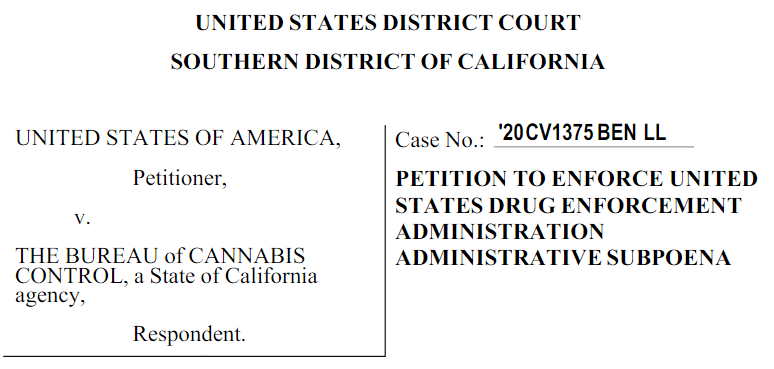
Here We Go! Feds Sue California for Cannabis Business Records

dea doj bcc litigation

State legal cannabis businesses are used to the specter of the federal government in the rear view mirrors of their lives and businesses. Unless you’ve been living under a rock, you know that cannabis remains federally illegal. And it’s not so much the case anymore that the Drug Enforcement Administration (DEA) or Department of Justice (DOJ) are coming to knock down your door and arrest and prosecute you as a cannabis business owner for open violations of the federal Controlled Substances Act (CSA). These days, life can be fairly miserable as a cannabis business owner due to the legal conflict between the states and the feds, resulting in a lack of access to financial institutions, onerous federal income tax obligations, no federal trademark protection, asset forfeiture, etc.

Rarely, though, do we get to see a state agency and the feds openly fight over these commercial cannabis democratic experiments (which is mainly due to the acting Attorney General’s “hands-off” approach to state legal cannabis, “Second Requestsscandal notwithstanding). When these confrontations happen, it’s fascinating to see how the respective governments behave and is always educational regarding evolving federal enforcement priorities.

And that is what made last week’s new so interesting. It seems that a beef has developed between the DEA, DOJ, and California’s Bureau of Cannabis Control (BCC), which the BCC oversees and licenses retailers, labs, distributors, and delivery companies in California. Keep in mind that to warrant federal attention at this point (at least per the rescinded 2013 Cole Memo and U.S. A/G Barr’s testimony regarding the same) a cannabis business would likely need to be engaged in fairly serious criminal conduct beyond just trafficking in cannabis pursuant to a state-issued license.

The basic gist of the fight between the feds and the BCC (per the DOJ’s July 20th court petition filing) is that the DEA and DOJ want specific information about six “entities” (which really means three corporations and each corporation’s “presumed owner”) that hold BCC licenses. The feds are conducting a criminal investigation (for violations of the CSA), and the BCC is refusing to provide that information.

Specifically, at the end of last year, the DEA served an administrative subpoena on the BCC (which it later withdrew and then re-issued an identical subpoena in January of this year) requesting unredacted cannabis licenses, cannabis license applications, and shipping manifests for these licensees from January 1, 2018 (when licensing began in California) through January 9, 2020. In the January subpoena (which is standard and boilerplate), the DEA wrote that “the information sought . . . is relevant and material to a legitimate law enforcement inquiry . . .”

In response, the BCC responded (via letter) that it wouldn’t produce the desired documents because the subpoena “does not specify the relevancy” and requested information that is “confidential, protected, and part of pending licensing investigations.” The DEA then, for a matter of months, tried to persuade and negotiate with the BCC and the California Attorney General to cooperate, but the BCC wouldn’t budge, so the feds took the matter to federal court for enforcement of the subpoena against the BCC. 

In its July filing, the DOJ/DEA mainly relies on DOJ/DEA compliance with its subpoena power and authority to investigate pursuant to the CSA, the corresponding procedural components, and that all was in line with the Fourth Amendment (which institutes a “reasonableness” requirement based on relevancy and scope of the subpoena, itself). The DOJ/DEA also uses the Supremacy Clause in its arguments to bypass the application of any California cannabis or privacy laws or regulations previously touted by the BCC in its letter earlier this year.

In response to the DOJ/DEA petition, on July 29th (as first reported by Marijuana Moment with a copy of the filing), the California Attorney General fought back, arguing that the DEA/DOJ failed to prove either the relevance or reasonableness of the subject subpoena (and also revealed that the DEA/DOJ is targeting distributors in this investigation). Importantly, the BCC admits that the DEA/DOJ complied with procedural requirements and that the DEA has the requisite authority from Congress to investigate violations of the CSA accordingly.

The BCC’s lone (and probably best) attack under federal law is that the DEA/DOJ failed to prove that the requested records are “relevant to the investigation,” and that the DEA “failed to include a statement [in the subpoena] describing how the subpoenaed records are in fact relevant to the DEA investigation.” California is taking the position that, at minimum, the DEA needs to produce an affidavit of an investigating DEA agent as to how and why the requested records are relevant to the current criminal investigation. The DEA’s/DOJ’s position on this is that the subpoena on its face demonstrates the records’ relevance to the DEA investigation.

The California A/G also cited California State laws regarding confidentiality, trade secrets, and privacy laws as justifications for non-disclosure, but it’s seemingly only raising those “defenses” in its role as a state administrative agency that’s obligated to take those positions regardless of federal law.

The main question at issue in this case is whether the subject subpoena demonstrates relevance on its face without further substantiation by the DEA (namely, via an affidavit by an agent on the investigation). My take is that the BCC will likely lose this battle and will eventually have to comply with the subpoena. The reason being that federal courts have no choice but to enforce federal administrative subpoenas unless (and this is a big unless) “the evidence sought by the subpoena is plainly incompetent or irrelevant to any lawful purpose of the agency,” which is a pretty low bar. On this point, DOJ/DEA cite to solid federal case law regarding how “unconstrained” this relevance standard is in application regarding administrative subpoenas. Plus, there is no requirement under federal law that a subpoena be accompanied by an affidavit or a declaration to achieve relevance.

While we’re certainly proud of the BCC for defending itself and forcing the DOJ/DEA through the paces of total and complete compliance around the federal administrative subpoena power, this isn’t one where we see the federal court siding with the State of California (but we’d be happily surprised if it did!). Several interesting things are bound to come out of this case/investigation, and this highlights most for cannabis businesses (especially in California) that the feds are indeed alive and well and still watching.

The post Here We Go! Feds Sue California for Cannabis Business Records appeared first on Harris Bricken.


from Canna Law Blog – Harris Bricken https://ift.tt/2PigljD
via IFTTT

Saturday, August 1, 2020

Federal Hemp CBD Policy Is Taking Shape: How Will Products Be Tested and Labeled?

fda cbd testing labeling

This is the second post in a two-part series. The first is available here

Last week, the Food and Drug Administration (FDA) submitted a CBD enforcement policy to the White House. We do not yet have the text of that document but we anticipate that it will have a significant impact on hemp-derived CBD (Hemp CBD) products. In my last post, I summarized the FDA’s current enforcement policy and briefly discussed the FDA’s recently released guidance for drug manufacturers interested in cannabinoid research. An issue that came up in the FDA’s guidance for drug manufacturers was testing finished and intermediary products for cannabinoids.

Here’s how the FDA frames the issue of testing hemp products in the drug guidance document:

In general, the composition of a botanical raw material is calculated as the amount of the compound(s) of interest naturally present relative to the dry weight of botanical raw material prior to extraction or other manufacturing steps. However, this type of dry weight calculation has limited utility for intermediates such as solutions, extracts in solution (whether aqueous or nonaqueous), and for finished products. Therefore, FDA recommends that sponsors, investigators, or applicants evaluating intermediates or finished products that contain cannabis or cannabis derived compounds base the calculation of delta-9 THC percentage on the composition of the formulation with the amount of water removed, including any water that may be contained in excipients.

Remember, this guidance is only intended to speak to drug manufacturers and even then it’s non-binding. But I think the FDA’s drug guidance could creep into its more general guidance. For example, the FDA provided the following guidance for determining delta-9 THC levels in liquid products:

For a solution-based material (intermediate, in-process material, or final drug product):
1. Determine the density of the liquid formulation and convert 1 mL of the formulation to mass units (mg).
2. Calculate water content (in mg) of each active and excipient component present in 1 mL of the formulation.
3. Sum the water content (in mg) for all components present in 1 mL of the liquid formulation and subtract this amount from the total mass of 1 mL (from step 1). This is the water-adjusted total mass of 1 mL of the formulation.
4. Calculate the mass, or mg amount, of delta-9 THC present in 1 mL of the liquid formulation.
5. Calculate the percentage delta-9 THC by dividing the mass of delta-9 THC from step 4 by the total water-adjusted mass in step 3 and multiplying by 100.

The FDA provides similar guidance for solid forms:

For a solid oral dosage form (e.g., tablet or capsule), this percentage is similarly calculated and would be the weight of delta-9 THC in the dosage unit divided by the total water-adjusted formulation weight multiplied by 100.

— For oral capsules, the mass of the capsule itself should not be included in the denominator weight. Include only the capsule fill.
— The water-adjusted formulation weight used in the calculation should reflect the removal (in mass units such as mg) of all water content present for each of the components, whether active or inactive, in the formulation.

A while back, I chastised the FDA for reporting on the fact that many Hemp CBD products sold on the market are listed with inaccurate levels of THC and CBD when the agency itself has the ability to implement industry-wide standards for labeling. To have accurate labels you need accurate testing and methodology. The FDA’s guidance for cannabinoid drug manufacturers touches on this issue by giving guidance on testing cannabinoids, specifically delta-9 THC, in solid and liquid form. I hope the agency will do the same when it issues broader CBD enforcement guidance.

Luckily, other federal agencies are also making moves in the testing world. Last week the National Institute for Standards and Technology (NIST) “launched a program to help laboratories accurately measure key chemical compounds in marijuana, hemp and other cannabis products including oils, edibles, tinctures and balms.” You can read NIST’s press release on the Cannabis Quality Assurance (CannaQAP) program here.

The NIST’s CannaQP testing program, once operational, will have an immediate impact on a problem that has plagued the Hemp CBD industry for years: inaccurate product labeling. Here is how NIST frames the issue:

The labels on most cannabis products list the concentration of at least two chemical compounds: tetrahydrocannabinol, or THC, the psychoactive ingredient that produces a high, and cannabidiol, or CBD, which is not intoxicating but is sought after for its many purported health benefits. However, most laboratories have limited experience making these measurements, which can sometimes be unreliable as a result.
The goal of the program, said NIST research chemist Brent Wilson, is to help labs produce consistent measurement results. “When you walk into a store or dispensary and see a label that says 10% CBD, you want to know that you can trust that number.”
Testing for THC percentages is a relatively new operation for most labs in the US. THC testing developed long before hemp was made legal, first by the 2014 Farm Bill for research purposes, and then by the 2018 Farm Bill for commercial purposes. The goal of THC testing prior to hemp legalization was to determine whether or not plant material was marijuana or whether a processed product contained marijuana. THC testing was mainly performed in the law enforcement context. Police would seize a product, test it for the presence of THC, and then charge for marijuana-related crimes.
NIST’s CannaQAP is designed to establish standards for labs testing processed hemp products:

Here’s how CannaQAP will work. In the first round of exercises, NIST will send hemp oil samples — all with the same, very carefully measured concentrations of THC, CBD and 15 other cannabinoid compounds — to participating labs. Those labs won’t be told the concentrations of those compounds but will measure them and send their results back to NIST, along with information about the methods they used to do the analysis.

After collecting responses, NIST will publish the measurements the labs obtained. That data will be anonymized so that the names of the individual labs are not revealed. However, the results will show how much variability there is between labs. Also, NIST will publish the correct measurements, so each lab will be able to see how accurate its measurements were and how it performed relative to its peers.

[. . . ]

NIST is also working on a hemp reference material — that is, a material that comes with known, accurate measurement values. Labs will be able to use that material to validate their measurement methods. One reason these measurements vary so much from lab to lab is that, currently, there are no reference materials for cannabis.

The CannaQAP will enable labs to better test for cannabinoids like THC and CBD. That will allow for accurate labeling of the CBD, along with other cannabinoids, in hemp products.

Hopefully, the CannaQAP and the eventual report from the FDA on CBD enforcement will bring clarity to the industry. We’ll keep monitoring but won’t hold our breath.

The post Federal Hemp CBD Policy Is Taking Shape: How Will Products Be Tested and Labeled? appeared first on Harris Bricken.


from Canna Law Blog – Harris Bricken https://ift.tt/2DtesOE
via IFTTT