Thursday, September 2, 2021

Granny Flips Off Police in Mugshot After Cannabis Farm Bust

When law enforcement officers searched an elderly woman’s house and farm last Monday in Jackson County, Tennessee, they got more than they bargained for.

Peggy Brewington told officers that there was “maybe an ounce” of pot on her farm before officers searched the premises and found dozens of cannabis plants and 20 pounds of flower.

After Drug Task Force officers booked the woman, she flipped off the camera for her mugshot as a token of defiance. The internet responded with hashtags like #freeweedgranny.

On August 30, the 15th Drug Task Force and Jackson County Sheriff’s Office conducted a search on the property after slowly building a case against her. Three days earlier, on August 27, Brewington was arrested for trespassing. The 15th judicial district Drug and Violent Crimes Task Force covers Trousdale, Smith, Macon, Jackson and Wilson Counties in Tennessee.

Photo courtesy of the 15th Drug Task Force Tennessee

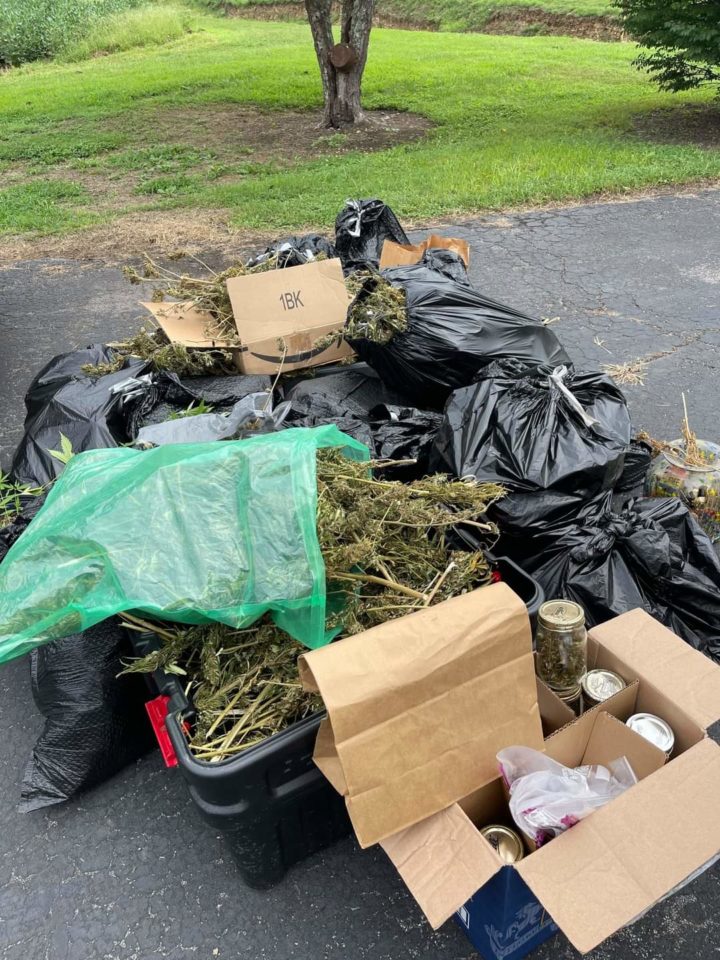
Officers confronted Brewington and asked how much pot was in the residence. Brewington replied, “maybe about an ounce.” Once the search was completed, officers recovered around 20 pounds of flower from the residence and approximately 40 cannabis plants from the property. 

A second search was conducted at a nearby residence and more growing marijuana and processed cannabis was recovered. All drug cases will be presented to the Jackson County Grand Jury. Agencies assisting with the search were the TBI and THP Eradication Task Force.

“Officers recovered over 20 pounds of marijuana from the residence and approximately 40 marijuana plants from the property,” the post reads. “A second search was conducted at a nearby residence and more growing marijuana and processed marijuana was recovered. All drug cases will be presented to the Jackson County Grand Jury.”
bust
Photo courtesy of the 15th Drug Task Force Tennessee

The officers at 15th Drug Task Force Tennessee—a government organization—posted three additional photos of lush cannabis plants being ripped from the soil on her farm and tossed in bags like trash.

Brewington was arrested, and promptly flipped off the camera in her mugshot, which is likely to go viral. In line with other cannabis-related arrest posts, reactions were mixed, and many commenters questioned if the streets are any safer without a nonviolent elderly woman growing pot in peace.

Marijuana in Tennessee is a Bust, So Far

As noted by some concerned commenters on the post of the arrest, “a law is a law,” and it’s illegal to grow cannabis, especially in the amounts Ms. Brewington was growing. Medical and adult-use cannabis cultivation and sales are illegal in the state. But that’s likely to change in Tennessee, possibly sooner than later.

Representative Bruce Griffey, a Republican representing District 75, introduced House Bill 1634 last month, slated for the 2022 ballot in the state. 

Tennessee still does not have a cannabis industry, and is only one of 14 states that still does not have some type of medical system in place. Call it an “island of prohibition.”

Senate Bill 854 was sponsored by Senator Janice Bowling and would have legalized medical cannabis for certain patients and developed a Medical Cannabis Commission that would have regulated the production and sale of cannabis. While the Senate Government Operations Committee approved the bill back in March, it was rejected by the Senate Judiciary Committee later that month.

Tennessee voters consistently support cannabis according to polls, but the state doesn’t have a voter initiative process. That means only elected officials can change state law, so the ballot initiative for 2022 won’t complete the entire process of legalization. For now, people like Brewington will have to resort to other, law-abiding hobbies.

The post Granny Flips Off Police in Mugshot After Cannabis Farm Bust appeared first on High Times.


from News – High Times https://ift.tt/3mZb3M2
via IFTTT

Massachusetts Adult-Use Cannabis Sales Eclipse $2 Billion

Less than three years after the first licensed recreational marijuana retailers began doing business in Massachusetts, regulated cannabis dispensaries have rung up more than $2 billion in adult-use cannabis sales, state officials announced on Wednesday. 

Shawn Collins, the executive director of the Massachusetts Cannabis Control Commission (CCC), reported that as of Tuesday night, regulated marijuana establishments had logged $2,009,007,478 in gross sales since the businesses first opened their doors on November 20, 2018.

“This milestone speaks to the success of licensees that have interacted with the Commission from the application stage, maintained compliance with our strict regulations and contribute every day to communities across the Commonwealth,” Collins said in a statement from the agency. 

“This number also underscores the entire agency’s tireless efforts, particularly those of our hardworking staff, to thoughtfully regulate a safe, accessible, and effective adult-use marketplace that keeps critical tenets of our mission—public health, public safety and equity, among others—front of mind.”

The news comes less than one year after regulated, adult-use cannabis sales hit the $1 billion mark on November 3, 2020. During the first year of licensed sales (November 2018 through 2019), 33 marijuana retailers generated $393.7 million in gross sales. Sales for all of the 2019 calendar year amounted to $444.9 million, the agency reported. 

In 2020, 91 adult-use cannabis retailers tallied $702 million in gross sales, despite being closed for two months due to the COVID-19 pandemic. Recreational marijuana dispensaries were designated as non-essential businesses by Massachusetts Governor Charlie Baker and ordered shuttered in March 2020 and then allowed to reopen the following May.

Massachusetts now has 165 licensed adult-use cannabis retailers and three recreational marijuana delivery services. As of Wednesday morning, regulators reported that $844 million in gross cannabis sales have already been made since January 1, putting 2021 on pace to be the year with the most licensed weed sales in Massachusetts ever.

Cannabis Control Commission Celebrates Fourth Anniversary

The Cannabis Control Commission also noted that Wednesday marked the four-year anniversary of the agency, which was launched after voters approved the legalization of recreational marijuana in 2016. Massachusetts became the 18th state to legalize medical marijuana with the passage of a ballot measure in 2012.

The CCC also noted in its statement the progress the agency has made over the last four years of operation. Since the first licensed recreational marijuana retailers began doing business in 2018, the CCC has approved an additional 163 shops that have already opened or are in the process of doing so. 

Taken together, the agency has approved a total of 908 marijuana establishments, including cultivators, processors, transporters, retailers, and more. Notably, the number of independent cannabis testing laboratories has increased from three to five in 2021.

Also this year, the CCC finalized regulatory changes that allow for the home delivery of marijuana products under three different business models. The agency began accepting applications for marijuana couriers, which were previously known as delivery-only licenses, in 2020. 

Since then, two marijuana couriers have been authorized to commence operations, five have received final licenses, 10 have received provisional licenses and seven more are in the review and approval process. Additionally, one cannabis microbusiness has been awarded a delivery endorsement, allowing the company to deliver its own products directly to customers’ homes.

“As the Commission reflects on our four years of work, I hope the Commonwealth is proud of the agency we have built and the new industry that has been introduced and established,” said Collins.

Additional information on the state’s recreational and medical marijuana programs is available on the Massachusetts Cannabis Control Commision open data platform.

The post Massachusetts Adult-Use Cannabis Sales Eclipse $2 Billion appeared first on High Times.


from News – High Times https://ift.tt/2WJywFV
via IFTTT

6 surprising ways to enjoy cannabis in Illinois

Sleep (and smoke) in a treehouse, go to cannabis camp, munch out at a potluck dinner, go 420 camping—and more!

The post 6 surprising ways to enjoy cannabis in Illinois appeared first on Leafly.


from Leafly https://ift.tt/3gYPhnL
via IFTTT

Surge of Advocacy Groups Weigh In on Federal Cannabis Reform Bill

Yesterday was the deadline for the comment period on the draft version of the federal cannabis reform bill, the Cannabis Administration and Opportunity Act (CAOA), and cannabis advocacy groups did not disappoint—with an avalanche of commentary rolling in before the time was up.

Senate Majority Leader Chuck Schumer (D-New York), Senate Finance Committee Chairman Ron Wyden (D-Oregon) and Senator Cory Booker (D-New Jersey) signed on as lead sponsors for a sweeping bill to end the prohibition of cannabis at the federal level.

The draft version of the measure was released in July, which led to an open public comment period giving people time to weigh in on what will be the revised measure.

Several well-known cannabis advocacy organizations such as the National Organization for the Reform of Marijuana Laws (NORML), the National Cannabis Industry Association (NCIA) and the Marijuana Policy Project (MMP) released their comments.

The Marijuana Justice Coalition opted to send a joint letter on the legalization proposal. The Marijuana Justice Coalition is made up of members including the ACLU, Center for American Progress, Drug Policy Alliance, Human Rights Watch, Leadership Conference on Civil & Human Rights, MoveOn, Students for Sensible Drug Policy and United Food and Commercial Workers International Union.

In a 30-page comment document, NORML called for strengthening civic protections to provide justice to those previously wronged by federal marijuana criminalization and revising outdated employment policies. The organization also called for ensuring that small and local businesses can compete both with larger corporations and the illicit market by reducing regulatory and tax burdens. NORML also asked to narrow the scope of the proposed excise tax to exempt medical cannabis consumer markets and balance the roles of the FDA, TTB, ATF and antitrust regulators.

“We appreciate the leadership by Senators Schumer, Booker, and Wyden in their efforts to end America’s failed, unjust, and racially biased experiment with cannabis prohibition. The CAOA draft represents a thoughtful path forward toward ending federal marijuana criminalization. We are confident that similar language, once finalized and formally introduced in the US Senate, will possess bipartisan appeal — as we know that voters of all political parties strongly support repealing the federal government’s failed marijuana policies,” said NORML Political Director Justin Strekal. 

The summary of NORML’s discussion draft can be read here.

MPP also stressed the importance of easing restrictions on medical cannabis patients. MPP outlined two major areas of concern: the possible upending of state licensing and regulatory systems, which does nothing but drive sales underground, and the impact on medical cannabis access, including for those under the age of 21.

“We are grateful for the leadership of Sens. Booker, Schumer, and Wyden to end an eight-decades long policy failure and appreciate the opportunity to provide feedback as the sponsoring offices refine the bill,” said Karen O’Keefe, state policies director at MPP. Federal prohibition urgently needs to end. It has wasted billions of dollars while upending tens of thousands of lives—disproportionately those of Black and Brown Americans—over a plant that is safer than alcohol.

The NCIA stated that the CAOA presents a “thoughtful foundation for comprehensive cannabis policy reform that clearly illustrates the authors’ engagement with stakeholders during the drafting process.” Read the NCIA’s full draft of recommendations here.

“Ending nearly a century of disastrous prohibition policies is a monumental effort and one which should not be taken lightly,” said Aaron Smith, co-founder and chief executive officer of NCIA. “We appreciate Senate leadership for taking a big step toward that goal which a significant majority of Americans support. There is a lot of work left to be done and it is vital to include those most impacted by both prohibition and the proposed legislation in this process.”

The wave of commentary represents the importance of the bill and how the industry hinges upon those fine details.

The post Surge of Advocacy Groups Weigh In on Federal Cannabis Reform Bill appeared first on High Times.


from News – High Times https://ift.tt/2WLHQcm
via IFTTT

Michigan Agency Launches Social Equity Program to Tackle Essential Issues

The Michigan Marijuana Regulatory Agency (MRA) launched a new program to improve social equity in the state’s cannabis industry.

On August 31, the MRA launched the Joint Ventures Pathway Program (JVPP), which is the culmination of an organized discussion that was held earlier this year. 

“Based on a recommendation made by the Racial Equity Advisory Workgroup earlier this year, the JVPP will connect eligible social equity participants—and those seeking to become social equity participants—with adult-use licensees, potential adult-use licensees, and any businesses that wish to work with social equity participants interested in pursuing partnerships, including: joint business ventures, mentorships, incubator program, employment,” the MRA’s statement reads.

When the Michigan Regulation and Taxation of Marijuana Act passed in 2018 by voter approval, it stated that the MRA was in charge of creating and enforcing all laws related to commercial cannabis businesses. It also directed the MRA to “create a plan to promote and encourage participation in the marijuana industry by people from communities that have been disproportionately impacted by marijuana prohibition and enforcement and to positively impact those communities.”

The MRA’s press release states that the law’s language was not enough to satisfy the needs for social equity in Michigan, so it created the Racial Equity Advisory Workgroup in 2020. The group was made up of local officials, state officials and “industry stakeholders,” such as Representative Sarah Anthony, Senator Marshall Bullock and business owners Anqunette Sarah and Tatiana Grant.  

This group met in July 2020 through December 2020 before releasing its final recommendations in January 2021

“The MRA is committed to making Michigan the model agency in the country, including being a leader in diversity, equity, and inclusion in the marijuana industry,” said Andrew Brisbo, MRA executive director, in a press release publishing the group’s final recommendations and explaining their plan for the organization. “As the agency responsible for implementing and administering the laws governing commercial licensure, the MRA recognizes the importance of equity in opportunity for businesses operating in this newly legalized industry.” 

The recommendations included 30 pages of what the state’s social equity model should look like, through the categories of social justice, business development, local equity, process and pathways, resource deployment and strategic partnerships (each category was assigned a team of four to five individuals). It focuses on how social equity could create a more inclusive industry for the state. 

In detail, the workgroup organized concepts for their respective category, identified any statutory or administrative rule changes that are needed, talked about where funding would come from and established specific responsibilities for the MRA.

According to data from Bureau of Justice Statistics, 80 percent in federal prison and 60 percent of people in state prison, who were incarcerated because of a drug offense, are Black or Latino. 

Results from data released by the MRA show that in 2020, only 3.8 percent of cannabis business owners were Black, and only 1.5 percent were Latino.

If you’re a Michigan resident and social equity eligible individual who’s interested in partnering with the JVPP, you can go here to submit your information. Likewise, if you’re a Michigan business owner who seeks to partner with social equity participants, you can become a JVPP partner here.

Michigan is already being noticed as one of the country’s thriving cannabis markets. Not only are efforts for social equity well under way, but the industry’s product variety and selection is rapidly growing.

State officials are working quickly to address industry concerns, such as the regulation of Delta-8 THC products. Michigan Attorney General Dana Nessel published a brief earlier this month that those who are fired for off-the-job cannabis consumption should still qualify for unemployment.

The post Michigan Agency Launches Social Equity Program to Tackle Essential Issues appeared first on High Times.


from News – High Times https://ift.tt/3jAWJay
via IFTTT

BREAKING: New York Appoints Heads of Cannabis Control Board and Office of Cannabis Management

At long last, New York has started formalizing its cannabis industry by appointing the Chairperson of the Cannabis Control Board (CCB) and the Executive Director of the Office of Cannabis Management (OCM).

Consistent with her public statements, Governor Kathy Hochul kickstarted the process by calling back New York’s legislature for an “Extraordinary Session” to consider several major issues, including the CCB and OCM appointments.

And so, on September 1, 2021, New York’s legislature approved the appointments of Tremaine Wright as the CCB’s Chairwoman and Christopher Alexander as the OCM’s Executive Director. Please meet our new Chairwoman and Executive Director, with a little information about their respective backgrounds and a summary of each role’s major responsibilities:

CCB Chairwoman: Tremaine Wright

What We Know:

Ms. Wright is a Brooklyn native and an attorney who was elected to New York’s State Assembly in 2016. Her district covered the Bedford-Stuyvesant neighborhood in Brooklyn as well as the northern portion of Crown Heights. She is a graduate of Duke University and the University of Chicago School of Law, and practiced law at Brooklyn Legal Services.

With her stellar educational background and experience as a practicing attorney, as well as her legislative experience, it appears that Ms. Wright is well-suited for getting the MRTA’s rules and regulations off the ground, with an eye towards the social and economic equity program.

CCB Chairperson Responsibilities in Conjunction with the CCB:

  • Limiting, or not limiting, the number of registrations, licenses, and permits of each class of license to be issued within the state or any political subdivision.
  • Creating the standards and requirements for medical cannabis, adult-use cannabis and cannabis product, and cannabinoid hemp and hemp extract.
  • Creating the form of applications for registrations, licenses, and permits, as well as all reports, deemed necessary by the CCB.
  • General power to exercise power and duties necessary to enact the MRTA, even if not specifically enumerated.
  • Establishing minimum criteria for certifying employees to work in the cannabis industry in positions requiring advanced training.
  • Advising the OCM and/or the Urban Development Corporation in making low-interest or zero-interest loans to qualified social and economic equity applicants.
  • Approving any price quotas or price controls set by the executive director
  • Approving the OCM’s social equity plan.
  • Issuing preliminary determination on whether a registration, license, or permit should be issued, rejected, or held for further action after receiving a recommendation and relevant application information from the OCM.
  • Sole discretion to revoke, cancel or suspend licenses and impose civil penalties (upon hearing)

OCM Executive Director: Christopher Alexander

What We Know: Mr. Alexander is also a native New Yorker and attorney. Mr. Alexander is the government relations and policy director at the cannabis company Vill LLC, a Multi-State Cannabis Company based in Canada. He was also an Associate Counsel in the New York State Senate and Policy Coordinator for the Drug Policy Alliance.

As a policy coordinator for the Drug Policy Alliance, Mr. Alexander should be well-suited to addressing the complex issues for implementing New York’s cannabis regulations. He was also involved in the negotiations and drafting of multiple versions of the MRTA, which should also facilitate a complementary and consistent set of rules and regulations for the industry.

OCM Executive Director Responsibilities:

  • Power of Office of Cannabis Management exercised through the Executive Director.
  • General power to promote the MRTA’s goals, even if not specifically enumerated.
  • Keeping records, including the names of the officers and directors of corporate licensees and the location of all licensed premises.
  • Inspecting or providing for the inspection of facilities authorized by MRTA
  • Prescribing the forms of applications for licenses and permits.
  • Delegating powers.
  • Performing duties as delegated by the CCB.
  • Advising and assisting the CCB.
  • Issuing guidance and advisories

While we are waiting to get to know Ms. Wright and Mr. Alexander better (specifically, their plans for New York’s rules and regulations), it is incredibly exciting that Governor Hochul has kickstarted this process. New York’s cannabis industry has finally taken a tangible step forward after the MRTA was enacted in March, and we look forward to more positive developments through the end of the year.

The post BREAKING: New York Appoints Heads of Cannabis Control Board and Office of Cannabis Management appeared first on Harris Bricken.


from Canna Law Blog – Harris Bricken https://ift.tt/2YnexxF
via IFTTT

510 vape cartridges to enjoy Labour Day, without the work

On Labour Day, weed shouldn't be work. Quick, easy, discreet—just twist and toke.

The post 510 vape cartridges to enjoy Labour Day, without the work appeared first on Leafly.


from Leafly https://ift.tt/3t7ivG5
via IFTTT