Tuesday, December 13, 2022

Cannabis Branding: U.S. Supreme Court Agrees to Hear Parody Trademark Case

Cannabis brands are known for clever branding and advertising. In some instances, this gets cannabis companies in trouble. See Cannabis Trademark Litigation: Wrigley Wins. Sometimes cannabis companies try to hew the parody line when riffing on an existing trademark. See Reminder: The Parody Defense to Trademark Infringement is Tricky. As my cannabis litigation colleague, Jihee Ahn, explained:

“parody is a type of speech protected by the First Amendment. It is a “distorted imitation” of an original work for the purpose of commenting on it. In the right circumstances, parody can be asserted as a defense to trademark infringement.”

The U.S. Supreme Court recently agreed to hear a trademark case involving parody, a maker of squeaky dog toys, and Jack Daniel’s whiskey. The case is Jack Daniel’s Properties Inc. v. VIP Products LLC. Jack Daniel’s says that plastic dog toys tarnish its brand and violate its trademark rights. The manufacturer of the toy, the “Bad Spaniels Silly Squeaker,” contends the toy is a humorous parodies entitled to First Amendment protection.  Here’s a visual:
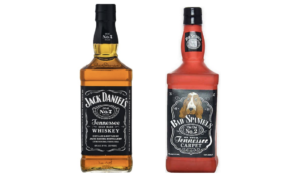
Jack Daniel’s demanded the manufacturer cease selling the toy. The manufacturer refused and filed a lawsuit seeking a declaration that the toy did not infringe on Jack Daniel’s trademark rights. The district court found in favor of Jack Daniel’s and issued an injunction that prevented the manufacture and sale of the squeaky toy. The manufacturer appealed and the Ninth Circuit affirmed in part, but found the dog toy is an “expressive work” protected by the First Amendment. It therefore reversed the trademark dilution claim, vacated the judgment on trademark infringement and remanded.

Jack Daniel’s appealed to the Supreme Court and numerous business, like Campbell Soup and Levi Strauss, urged the court to take the case.

The Court is expected to hear argument in the spring of 2023. So stay tuned for updates on what is likely to be an important opinion on parody and trademark.

For more reading on cannabis and trademarks, see:

The post Cannabis Branding: U.S. Supreme Court Agrees to Hear Parody Trademark Case appeared first on Harris Bricken Sliwoski LLP.


from Canna Law Blog™ https://ift.tt/e94RvUL
via IFTTT

Brittney Griner is Free, But Another American Remains Locked Up in Russia for Pot

Brittney Griner is back on American soil following ten months in Russian custody on drug charges. But other U.S. citizens remain locked up in Russia, including a 61-year-old man whose detention mirrors the experience of Griner. 

Politico published a story last week on Marc Fogel, who was arrested last year after Russian authorities found medical marijuana in his possession. 

“Fogel’s case bears a striking similarity to Griner’s, which has captured national headlines since the WNBA star was detained in Russia in February 2022. Like Griner, Fogel — a 61-year-old history teacher from Pennsylvania who lived in Russia while teaching at the Anglo-American School in Moscow — was taken into custody by Russian authorities in August 2021 after customs officials at a Russian airport discovered around half an ounce of medical marijuana stashed in his luggage,” Politico reported. 

“The drugs had been prescribed to him by doctors in the U.S. to help treat chronic pain stemming from a series of injuries and operations, but Fogel’s reasons didn’t matter. Ten months later, in June 2022, a Russian court convicted him of drug trafficking charges and sentenced him to 14 years in prison. In October, Fogel was transferred from a Moscow detention center to one of Russia’s notorious penal colonies, where he is slated to serve the remainder of his sentence,” the outlet continued

Griner, a perennial all-star for the WNBA’s Phoenix Mercury and one of the most decorated women’s basketball players ever, was released last week after U.S. and Russian officials negotiated a prisoner swap. In exchange for the release of Griner, the U.S. agreed to free Viktor Bout, a Russian arms dealer who had been serving a 25-year prison sentence in the United States.

The deal drew some criticism from those who lamented the release of Bout, nicknamed the “Merchant of Death.” There was also disappointment that the U.S. was unable to also secure the release of Paul Whelan, a U.S. citizen who has been detained by Russia since 2018 on espionage charges.

U.S. officials sought a two-for-one deal –– Griner and Whelan in exchange for Bout –– but such an arrangement never materialized.

“We’ve not forgotten about Paul Whelan,” President Joe Biden said last week following Griner’s release. 

Griner was arrested at a Russian airport in February after officials found a small amount of cannabis oil in her luggage. She pleaded guilty to the charges, but said she did not intend to break the law. In August, a Russian court found her guilty and sentenced her to nine years in prison. 

Griner’s detention attracted international attention, and emerged as a diplomatic standoff between the United States and Russia. Foley’s case, meanwhile, has flown decidedly under the radar. 

“The State Department has not granted him “wrongfully detained” status, despite repeated appeals from a bipartisan group of lawmakers and Fogel’s lawyers. (A spokesperson for the State Department declined to comment on the specifics of Fogel’s case, saying: “The Department continuously reviews the circumstances surrounding the detentions of U.S. nationals overseas, including those in Russia, for indicators that they are wrongful.”) In the media, Fogel’s detention has been overshadowed by the coverage of Griner and Paul Whelan, an American businessman and former Marine who has been held in Russia since 2018 on espionage charges,” Politico reported last week.

“It’s a bit mysterious to me why we [aren’t] talking about three Americans — now, thankfully, two Americans — instead of just one,” said Michael McFaul, the former U.S. ambassador to Russia, told Politico. “He’s not just some random guy that got arrested — he was part of our community … He taught our kids, the kids of U.S. government officials and he taught our military’s kids.”

The post Brittney Griner is Free, But Another American Remains Locked Up in Russia for Pot appeared first on High Times.


from News – High Times https://ift.tt/LN3mMey
via IFTTT

Monday, December 12, 2022

Here’s how New York’s legal weed delivery will work

The state will allow its first recreational stores to fulfill orders through delivery while it gradually introduces brick-and-mortar shops.

The post Here’s how New York’s legal weed delivery will work appeared first on Leafly.


from Leafly https://ift.tt/dWG2HLo
via IFTTT

Here’s why police are raiding psychedelic mushroom stores in major cities

Brazen entrepreneurs in San Francisco, Toronto and Portland have all been reprimanded. Portland still bans retail sales, despite statewide decrim.

The post Here’s why police are raiding psychedelic mushroom stores in major cities appeared first on Leafly.


from Leafly https://ift.tt/1RYHfNE
via IFTTT

Baja California Governor Says She’s ‘Totally Behind’ on Medical Cannabis

The leader of the Mexican state Baja California offered a full-throated endorsement of medical cannabis last week as debate surrounding the issue continues to rankle lawmakers in the country.

Marina del Pilar Avila, who serves as governor of Baja California, told reporters that she is “totally behind the legalization of marijuana as a way to treat chronic illnesses,” as quoted by the news outlet Border Report

As the outlet noted, currently “the Mexican Senate is debating legalizing the widespread use of pot in Mexico.”

But Avila’s endorsement of the treatment is not shared by other leaders in Baja California. 

Norma Bustamante, the mayor of Mexicali, which is the capital city of Baja California, “came out against Avila’s statement” almost immediately, according to Border Report.

“As a public servant, I’m always respectful of the law and as a woman, mother and grandmother of teenagers, I am against the use of drugs including marijuana and even cigarettes,” Bustamante said, as quoted by Border Report

Adrián Medina Amarillas, who serves as the health secretary of Baja California, begs to differ.

“When the country allows the use of medical marijuana, we’ll be among the first to use it to treat chronic illnesses that don’t respond to conventional treatments among them cancer and Parkinson’s,” Medina said, as quoted by the outlet.

Long a robust producer and exporter of cannabis, Mexico’s marijuana laws are shrouded in ambiguity. As Leafly puts it: “It’s complicated.”

“Marijuana currently exists in a legal flux state in Mexico. It’s not entirely legal, but it’s not entirely illegal either,” Leafly explains. “Medical cannabis is technically legal in Mexico, but there is no legal framework in place to obtain a prescription or prove one’s own legal medical status. Possession of up to 5 grams of cannabis for any purpose, medical or otherwise, has been effectively decriminalized nationwide, although local and federal police often do not respect this status.”

As for recreational pot, possession “of up to 5 grams of cannabis is effectively legal since it was decriminalized federally in 2009, along with limited amounts of a number of other drugs, by authorities seeking to free up resources and separate public health issues from traffic crimes.”

“People found with less than 5 grams of cannabis should, according to the law, be encouraged into free treatment programs, but in reality they are still coerced into paying police bribes to be released from custody. They are generally not prosecuted for personal amounts, though the law states that purchasing and possessing amounts in excess of 5 grams can carry prison sentences of 10 months to 3 years,” Leafly explains.

The uncertain nature of that policy has prompted advocates and lawmakers to call for comprehensive cannabis reform. 

In August, Olga Sánchez Cordero, president of the Senate Board of Directors, “urged approval of the reform to regulate cannabis, since she considered that Mexico is lagging behind in the matter compared to Latin America and the world,” according to the Mexican news magazine Proceso

The magazine reported that, in Sánchez Cordero’s inaugural speech, she “recounted that Senator Margarita Valdez, president of the Upper House Health Committee, held a meeting in which representatives of Latin American countries asked her why Mexico did not regulate everything related to consumption of marijuana.”

“Now Senator Margarita Valdez told me that in a meeting she had, all our South American, Chilean, Argentine, Colombian brothers, in short, asked her when Mexico will take this important step in the regulation of cannabis. In my opinion, and I tell you this with all sincerity, I believe that we are falling behind the world if we do not make progress on this issue,” Sánchez Cordero, as quoted by Proceso

Additionally, the outlet reported that she “mentioned other issues on the legislative agenda that are relevant and that will be discussed during the next regular session that begins on September 1, such as the National Code of Civil and Family Procedures, consumer protection, issues of a energy and the protection of the human rights of migrants.”

The post Baja California Governor Says She’s ‘Totally Behind’ on Medical Cannabis appeared first on High Times.


from News – High Times https://ift.tt/fWvq3J4
via IFTTT

Rhode Island Rakes In $1.6 Million in First Week of Recreational Pot Sales

Rhode Island’s new adult-use cannabis market opened for business earlier this month, and so far, business is good. 

Local news station WPRI, citing the state’s Department of Business Regulation, reported this week that “Rhode Island’s six marijuana dispensaries — five of which are currently authorized to sell to recreational customers — collectively sold just over $1.63 million worth of marijuana from Dec. 1 to Dec. 7.” 

“Less than half of those sales were for recreational marijuana, at about $786,000. The rest, about $845,400, were sales to medical marijuana patients,” the station reported. “For comparison, during the last week of October — the most recent full week available prior to recreational sales — the dispensaries collectively sold $1 million worth of medical marijuana.”

Rhode Island legalized recreational cannabis use in May, when Gov. Dan McKee signed a bill that was passed by lawmakers in the state General Assembly

The law made it legal for adults aged 21 and older to cultivate and possess marijuana, while also establishing the regulatory framework for cannabis sales. 

“This bill successfully incorporates our priorities of making sure cannabis legalization is equitable, controlled, and safe,” McKee, a Democrat, said in a statement at the time. “In addition, it creates a process for the automatic expungement of past cannabis convictions. My Administration’s original legalization plan also included such a provision and I am thrilled that the Assembly recognized the importance of this particular issue. The end result is a win for our state both socially and economically.”

Additionally, the law “will give courts until July 1, 2024, to automatically expunge past convictions, and those who want their expungement sooner may request it,” the governor’s office explained in a press release at the time.

Late last month, McKee and the state’s Department of Business Regulation’s Office of Cannabis Regulation announced that “five licensed medical marijuana compassion centers have received state approval to begin selling adult use marijuana on or after December 1.”

The five “compassion centers” that were given approval to begin adult-use sales are: Aura of Rhode Island (Central Falls); Thomas C. Slater Center (Providence); Mother Earth Wellness (Pawtucket); Greenleaf Compassionate Care Center (Portsmouth); and RISE Warwick (Warwick).

“This milestone is the result of a carefully executed process to ensure that our state’s entry into this emerging market was done in a safe, controlled and equitable manner,” McKee said last month. “It is also a win for our statewide economy and our strong, locally based cannabis supply chain, which consists of nearly 70 licensed cultivators, processors and manufacturers in addition to our licensed compassion centers. Finally, I thank the leadership of the General Assembly for passing this practical implementation framework in the Rhode Island Cannabis Act and I look forward to continuing our work together on this issue.”

Matt Santacroce, who is serving as interim deputy director of the Rhode Island Department of Business Regulation, said last month that the state was “pleased with the quality and comprehensiveness of the applications we received from the state’s compassion centers, and we are proud to launch adult use sales in Rhode Island just six months after the Cannabis Act was signed into law, marking the Northeast’s fastest implementation period.”

“We look forward to continuing to work with the state’s cannabis business community to ensure this critical economic sector scales in compliance with the rules and regulations put forward by state regulators,” Santacroce said. 

The launch of recreational sales on December 1 was only one change to Rhode Island’s existing marijuana policy to arrive this month. 

WPRI reported that, on the same day, “the state also stopped charging medical patients to obtain or renew their medical marijuana cards,” adding that “there is an expected revenue loss from the pending plan to expunge marijuana possession charges, which will eliminate court fees from those crimes.”

The post Rhode Island Rakes In $1.6 Million in First Week of Recreational Pot Sales appeared first on High Times.


from News – High Times https://ift.tt/wQGjxOV
via IFTTT

Cosmetics and Cannabis

Cosmetics are something of a bright spot when it comes to federal cannabis regulation. Unfortunately, however, there is quite a bit of misunderstanding when it comes to the federal legal framework for cannabis cosmetics. Following up on question that was asked during a recent webinar, here are the basics of which cannabis brands should be aware.

First, the distinction between hemp and marijuana applies to cosmetics. If a cosmetic’s THC content exceeds 0.3%, it is considered marijuana and is a controlled substance under federal law.

Second, provided its THC level does not exceed 0.3%, there is no prohibition on the use of cannabis as a cosmetics ingredient. According to FDA, “certain cosmetic ingredients are prohibited or restricted by regulation, but currently that is not the case for any cannabis or cannabis-derived ingredients.”

This available legal space sets cosmetics apart from other products, such as foods. Under the drug exclusion rule, foods to which CBD or THC has been added cannot be legally sold or marketed in the United States (even if the THC does not exceed the 0.3% threshold).

Third, while the presence of cannabis as an ingredient does not by itself render a cosmetic unlawful, brands must comply with other regulations. For one, even though cannabis is not a prohibited ingredient, brands must ensure that their products do not contain any of the ingredients that are prohibited. In addition:

“no ingredient – including a cannabis or cannabis-derived ingredient – can be used in a cosmetic if it causes the product to be adulterated or misbranded in any way. A cosmetic generally is adulterated if it bears or contains any poisonous or deleterious substance which may render it injurious to users under the conditions of use prescribed in the labeling, or under such conditions of use as are customary or usual.”

Finally, depending on its intended use, a cosmetic can also be considered a drug, as defined in the Federal Food, Drug, and Cosmetic Act. Drugs are intended to “affect the structure or function of the body, or to diagnose, cure, mitigate, treat or prevent disease.”

Depending on a cosmetic’s nature, the line between being considered a drug or not is a fine one. It is however a line of great legal import. A CBD cosmetic may be lawful under federal law, provided it meets all of the legal requirements for cosmetics. On the other hand, a CBD drug is certainly unlawful.

The post Cosmetics and Cannabis appeared first on Harris Bricken Sliwoski LLP.


from Canna Law Blog™ https://ift.tt/HrDkpv2
via IFTTT